Social Media Management for Fashion Brands and Home Decor
If you sell clothes, shoes, jewelry, rugs, lamps or furniture, your Instagram grid is often the first store a customer walks into. They scroll, they stop on a color or a texture, and within a few seconds they decide whether you look like a brand they can trust with their money.
That is why social media management for fashion brands and home decor stores is its own job. It is not about posting every day or chasing every trend. It is about showing products the way people want to see them, at the moments they are ready to buy, and answering fast when they ask about price, size or delivery.
This guide is for owners and marketers of small and medium brands in the US and Pakistan. It covers platforms, content, occasions like Eid and the US holidays, creators, and a monthly routine you can keep up with.
Why social media comes first for fashion and home decor
People buy these products with their eyes. A customer cannot touch the fabric of a lawn suit or stand on a hand knotted rug through a screen, so your photos and videos have to do that work. How does the dupatta fall when someone walks? How big is an 8 by 10 rug next to a sofa? Does the brass lamp look warm or yellow at night? Good content answers those questions before anyone has to ask.
The audiences are big in both markets. In the US, Pew Research Center found that 50 percent of adults use Instagram, including 55 percent of women and 44 percent of men, and 37 percent use TikTok.
In Pakistan, DataReportal's Digital 2026 report counted 22.4 million Instagram users in late 2025, based on Meta's advertising tools. NapoleonCat put the figure at about 25.6 million by September 2026, with people aged 18 to 24 as the largest group.
One detail Pakistani brands should not skip: these audiences lean male. NapoleonCat counts 64.3 percent of Instagram users in Pakistan as men, and DataReportal reports that 79.2 percent of Facebook's adult ad audience there is male. If most of your buyers are women, do not assume broad targeting will find them. Check who actually follows, saves and messages you. And remember that men buying gifts, especially jewelry and wedding pieces, are customers too.
Pick two platforms, not five
Most small brands spread themselves across five apps and do all of them badly. Two platforms done well beat five done halfway.
For almost every fashion and decor brand, Instagram is the base. It is where people check whether you are real, look through your past work and send you a message. Then add one more, based on how your customers shop:
TikTok if you sell fashion to younger buyers and you are comfortable on camera. Try on videos, styling ideas and quick takes on trends work well here.
Pinterest if you sell home decor, bridal or occasion wear. People use it to plan, so a good pin can keep bringing visitors for months. Pinterest says its users run more than 80 billion searches a month, most of them visual and more than half of them commercial.
Facebook if your buyers are a little older, or if you rely on community groups and local events. In Pakistan it is still huge: DataReportal reported 52.9 million Facebook users in late 2025.
Instagram marketing for clothing brands usually pairs best with TikTok. Social media for home decor brands usually pairs best with Pinterest, because decor buyers save ideas for weeks before they buy. Pinterest and Google Images bring slower traffic than a viral Reel, but it lasts much longer. We cover that search side in our SEO guide for interior designers and home decor brands.
Keep your name, photo, bio and link the same on both, so a customer always knows they found the same store.
A simple content mix you can keep up with
Posting only product shots with prices makes a feed look like a catalog. Posting only pretty lifestyle photos means nobody knows what you sell. You need a mix.
One Pakistani agency, BrandVerse PK, suggests a split of 40 percent product posts, 30 percent lifestyle and inspiration, 20 percent behind the scenes and 10 percent promotions. Treat that as a starting point, not a rule. If your behind the scenes posts get the most saves, give them more room.
What each type looks like
Product: one item, shown clearly. Front, back, a close up of the fabric or weave, the item next to something familiar for scale, and the price if you are comfortable sharing it.
Lifestyle: the product in real life. An outfit at a mehndi, a rug under a dining table with toys on it, a lamp switched on in the evening.
Behind the scenes: the karigar stitching, a rug being washed, packing orders on a busy day, the owner choosing fabrics. This builds trust faster than most ads.
Promotions: sales, new drops, free delivery weekends. Keep these rare so they still mean something.
Social media content ideas for home decor
Decor products do not change every week, so ideas run dry. These keep working:
Before and after room shots using your pieces
The same rug or cushion styled three ways
Two options side by side with the question "Which one would you pick?"
Care tips, like how to clean a wool rug or polish brass
Customer homes, shared with permission
Size guides showing a 5 by 8 and a 9 by 12 in the same room
Fashion brands can use the same ideas with outfits, fit notes and customer photos.
Reels and short video basics
Short video is where new people find you, and the basics are simpler than they look.
Frameflow Creatives' video guide for Pakistani brands lists practical rules that hold up in the US too:
Shoot vertical at 9:16 (1080 by 1920 pixels) instead of cropping horizontal footage later.
Keep most videos under 60 seconds.
Hook viewers in the first 3 seconds. Open with the reveal, not your logo.
Burn captions into the video, because most people watch with the sound off.
Aim for three to five Reels a week on a predictable schedule.
Film in batches, one or two days a month, so you are not shooting every morning.
It helps to know what Instagram pays attention to. Instagram head Adam Mosseri has said the top three ranking signals are watch time, likes and sends, and that sends matter slightly more for content shown to people who do not follow you, as Social Media Today reported. Fashion and decor are made for sending: an outfit to a sister before a wedding, a rug to a partner with "for the lounge?" So make content that is easy to send.
Shot ideas that work in both categories:
A slow walk toward the camera so the fabric moves
Flipping a rug corner to show the back and the knots
Switching a lamp on as the room goes dark
For editing apps, templates and AI tools, see our guide to AI video and design tools for social media. The tools matter less than a steady habit of filming.
Time your content to real occasions
Fashion and decor sales follow the calendar. The brands that win a season start talking before customers start shopping.
Pakistan
The SquarePeg, an Islamabad agency, recommends creating Eid collection content two to three weeks before the festival and running wedding season collections from October. That matches how people shop. They plan outfits and gifts early, and tailors need time.
For planning ahead, the UAE's Astronomy Centre expects Ramadan 2027 to begin around February 8 and Eid ul Fitr to fall on March 9 or 10, The National reported. Dates in Pakistan depend on the moon sighting and can differ by a day, so treat these as planning dates. Either way, your Eid shoot should be finished before Ramadan starts.
United States
For US brands, the big window is the holiday season. In 2026, Thanksgiving falls on November 26, Black Friday on November 27 and Cyber Monday on November 30. Gift guides for jewelry and accessories should be live before then. For decor, think hosting season: dining rugs, table linens, lighting and guest room updates in November and December, then a fresh start in January when people reset their homes. Valentine's Day matters for jewelry, and spring brings another round of home refresh content.
Build a 90 day occasion calendar
List every date that matters to your buyers over the next 90 days: festivals, holidays, wedding season, school breaks and your own launches.
Mark when shopping starts, not the event date. For Eid that is two to three weeks before. For Black Friday, start teasing a week or two early.
Work back from there to set a shoot date and an edit date.
Pick one hero product or collection per occasion so your message stays clear.
Leave one open slot each week for trends or customer content you did not plan.
Working with creators without wasting money
Influencer marketing for fashion brands does not need a celebrity. For most small brands, a handful of smaller creators whose followers trust them will sell more than one big name.
The SquarePeg says that in Pakistan, micro influencers with 15,000 to 80,000 followers see engagement rates of 4 to 9 percent, compared with around 1 percent for celebrities. The agency does not cite a study for those numbers, so read them as one agency's observation, not research. It also suggests clothing brands put around 60 percent of an influencer budget into Instagram and 40 percent into TikTok, then move money after six weeks toward whichever platform brings sales at a lower cost.
A simple way to start:
Choose creators whose audience looks like your buyer. Read their comments, not just their follower count. Real questions about where to buy are a good sign.
Write a clear brief. Include the product, the one message you want across, the details they must show (fit, fabric, size), what to avoid, the posting date and whether you can reuse the video in ads.
Give each creator a tracked link or discount code. Without it you are guessing which one worked.
Run a small paid trial first. Three to five creators, one product, one month. Then keep working with the ones who brought orders.
A recent Instagram feature makes creator content more useful. In September 2026 Instagram started letting people add posts they are tagged in to their own profile grid, TechCrunch reported, while the original post stays where it is. So a strong creator post or customer photo that tags your brand can now sit on your own grid, where new visitors see it first.
A creator who mentions you on their own blog helps your search visibility too, as our post on backlinks and brand mentions explains.
Connect social media to search
Here is a gap many brands miss. A customer sees your Reel and likes the rug. A week later they ask Google or ChatGPT for a 9 by 12 wool rug near them, or an embroidered lawn suit under 10,000 rupees. If your product details only live in captions and DMs, search engines and AI assistants cannot find them.
Keep the same facts in both places:
Use the same product names on social and on your website, so "Ivory Garden Rug" is not "cream floral carpet" somewhere else.
Put sizes, materials, care instructions, price and delivery times on the product page, not just in replies.
Turn the questions you keep getting in DMs into an FAQ on the website.
Link your bio and stories to the exact product or collection page, not just your home page.
Our guide to ecommerce SEO for product and category pages walks through how to set those pages up. To understand how AI assistants decide which brands to mention, start with what generative engine optimization is, then check how ChatGPT and Gemini see your brand today.
Pinterest is moving closer to search as well. In September 2026 it announced Visual Search Ads, a format that appears in search results and on Pin closeups, launching in beta for eligible advertisers in all its ad markets. It also announced Restyle, a beta in the US and Canada that lets people use a photo to test ideas for their home. For decor brands, that is one more reason to have clean, well lit product photos and a few in room shots of every key piece.
Have a showroom? Keep your hours and address the same on social and on Google. Our local SEO playbook covers that side.
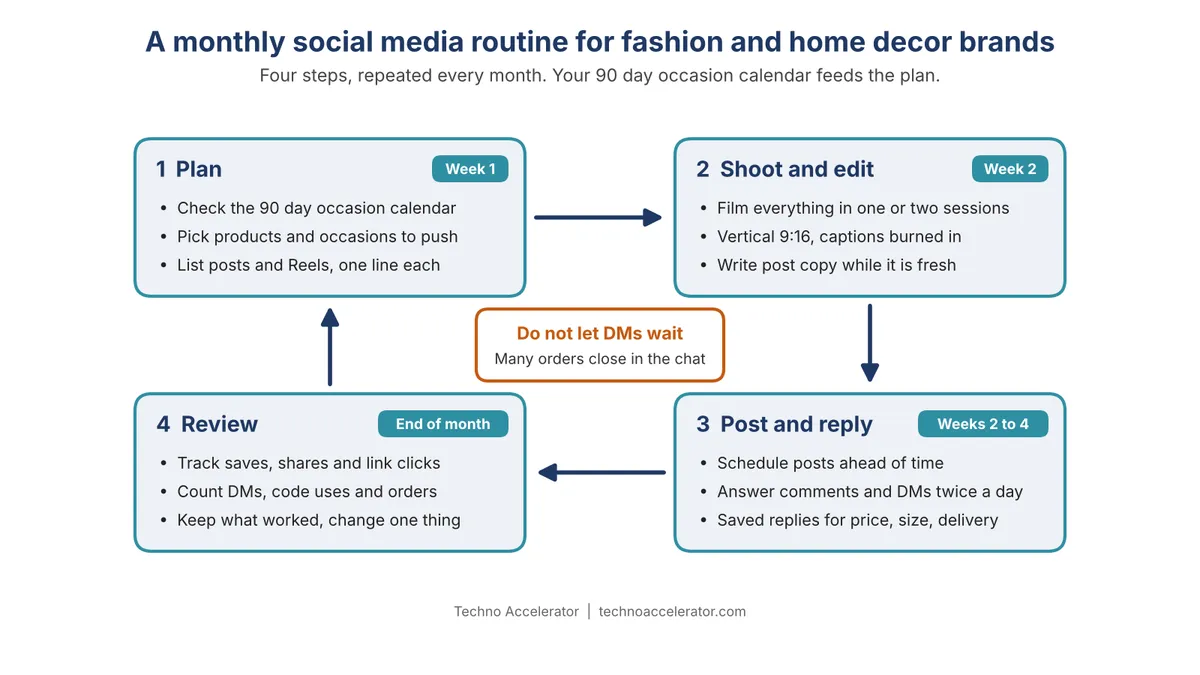
A simple monthly routine
The brands that do well on social are rarely the most creative. They are the most consistent. Here is a routine a small team, or one busy owner, can run every month.
Week 1: Plan
Open your 90 day calendar. Pick the products and occasions to push this month. Write a short list of posts and Reels with a one line idea for each, using the content mix as a guide.
Week 2: Shoot and batch edit
Film and photograph everything for the month in one or two sessions. Edit in a batch, add captions and write the post copy while the shoot is fresh. Our hybrid content workflow shows how AI can speed up drafts while a person keeps the voice right.
Weeks 2 to 4: Schedule and reply every day
Schedule posts ahead so you are never posting in a rush. Then set aside time twice a day for comments and DMs.
Fast replies matter more than most owners think. For a lot of Pakistani brands, the DM or WhatsApp chat is the checkout. The customer asks the price, the size and whether cash on delivery is available, and the sale happens right there. In the US a slow reply also sends buyers somewhere else. Save ready made replies for common questions so anyone on the team can answer well.
End of the month: Review
Look past likes. The numbers that tell you whether social is selling are:
Saves and shares: people want to come back or show someone
Link clicks: people want to see more
DMs and inquiries: people are close to buying
Orders and code uses: people bought
Write down what worked, what did not, and one change for next month. Then go back to week 1. After a few months you will have your own data, which beats any general advice, including this guide.
Deciding where social fits next to your other marketing? Our companion post on AI marketing for small businesses helps you set priorities, and the ideas in measuring SEO ROI work for social too.
What to do next
Pick your two platforms this week. Build a 90 day calendar with your next three occasions. Then film one batch of Reels and watch what people save and send.
If you would like a hand, Techno Accelerator plans and manages social media and content for small brands. You can look at our services or book a free call to talk through your brand.
Frequently asked questions
How often should a fashion brand post on Instagram?
Post on a schedule you can keep every week. For most small fashion brands that means a few Reels a week plus regular stories, with feed posts in between. A steady rhythm for three months does more than a burst of daily posting followed by silence.
Which social media platform is best for home decor brands?
Start with Instagram, because that is where buyers check your work and send messages. Add Pinterest as your second platform, since people use it to plan rooms and save ideas for weeks before they buy, and pins keep bringing visitors long after you post them.
Do small fashion brands need influencers?
Not big ones. A few micro creators whose followers match your buyers usually work better than one celebrity. Start with a small paid trial, give each creator a tracked link or code, and keep working with the ones who bring real orders.
When should we start posting Eid or holiday content?
Start when people start shopping, not on the day itself. For Eid, plan to post two to three weeks before the festival and shoot well before that. For US holidays, have gift and hosting content live in early November, before Black Friday.
What should we track to know if social media is working?
Track saves, shares, link clicks, DMs and orders, not just likes and followers. Give creators and campaigns their own codes or tracked links so you can see which posts led to sales, and review the numbers once a month.
Do we still need a website if we sell through Instagram DMs?
Yes. Google and AI assistants cannot read your DMs. A simple website with clear product pages, sizes, prices and an FAQ helps new buyers find you through search and gives your followers a trusted place to check details before they order.