
What Is Generative Engine Optimization (GEO) and How Does It Differ from Traditional SEO?
The decade-long playbook of rankings, backlinks, and keyword density is not dead. But it is no longer sufficient. A new discipline is rewriting the rules of AI search visibility, and brands that fail to adapt will simply not exist inside AI-generated answers.
Key Points at a Glance
Generative Engine Optimization (GEO) means structuring content so AI systems like ChatGPT, Google AI Overviews, and Perplexity cite it inside generated answers.
Traditional SEO targets search rankings and clicks. GEO targets citation frequency inside AI answers, many of which send zero clicks to your site.
SEO and GEO are complements, not competitors. Strong technical SEO foundations directly support GEO performance.
Factual density, authoritative sourcing, FAQ formatting, and schema markup are the four highest-impact GEO signals.
Niche and local businesses often hold a structural GEO advantage over large generic platforms, if they write for it deliberately.
GEO measurement is still maturing. Manual AI auditing, brand monitoring, and branded search trends are the current benchmarks.
What Is Generative Engine Optimization (GEO)? A Definition
Generative Engine Optimization (GEO) is the practice of structuring, framing, and positioning web content so that AI-powered answer engines understand it, trust it, and cite it in their generated responses. These systems include ChatGPT, Google AI Overviews, Perplexity, Microsoft Copilot, and other large language model (LLM) interfaces.
How AI Search Is Replacing Traditional Search Results
What changed in 2024 and why the old SEO playbook no longer covers the full picture.
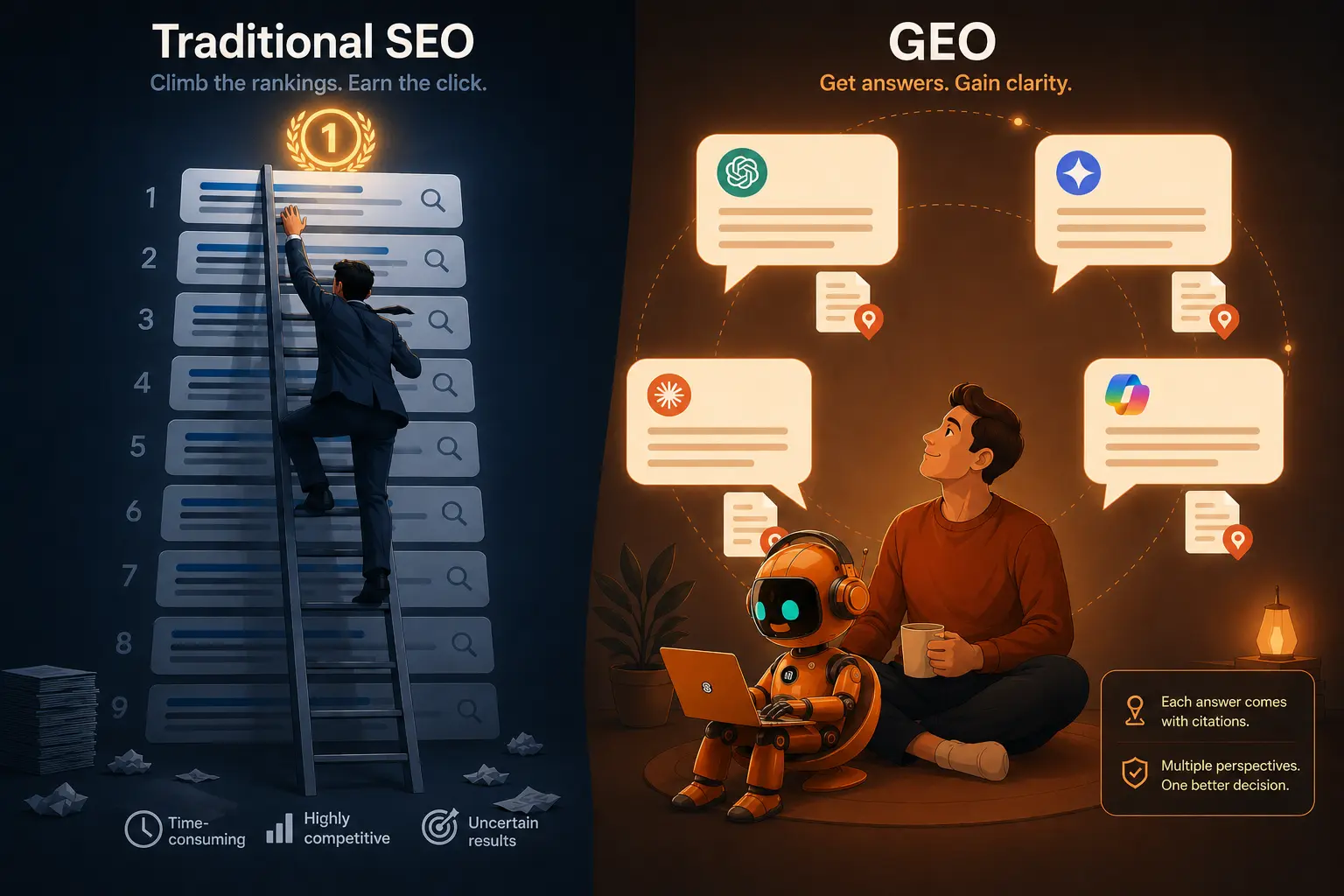
In 2013, brands scrambled to adapt to Hummingbird. In 2015, RankBrain changed how Google read intent. In 2019, BERT pushed everyone to write for people, not machines. Each update forced an evolution, but the basic contract between a website and a search engine held firm: publish content, earn links, climb rankings, get traffic.
That contract is now being renegotiated. Not by Google alone, but by a generation of AI systems that do not send users to your website at all. They answer the question directly, synthesising information from multiple sources and generating a response that often makes the blue-link result irrelevant.
When Google launched Overviews across major markets in mid-2024, it changed the topology of search. For informational queries, the kind that drive enormous traffic to blogs and knowledge-based businesses, the top of the results page is now occupied by a synthesised, AI-generated paragraph. Click-through rates for top organic positions dropped significantly once AI Overviews became the default experience.
Meanwhile, over 100 million users now interact with ChatGPT monthly. Perplexity AI was processing hundreds of millions of queries per month by late 2024. A growing segment of users has started conducting their entire search behaviour within these platforms and bypassing search engines altogether.
Ranking on Page 1 of Google matters. Being cited inside a ChatGPT response matters more because there is no Page 2 in a generated answer.
How Generative Engine Optimization Works: The Technical Mechanism
Understanding how LLMs retrieve and cite content is the foundation of any GEO strategy.
To optimise for something, you need to understand its internal logic. Traditional search engines use crawlers, indexers, and ranking algorithms. Generative engines work on a fundamentally different mechanism.
Systems like ChatGPT, Perplexity, and Google AI Overviews are built on large language models (LLMs) trained on vast text corpora. When they receive a query, they do not retrieve and rank documents. They generate a response, constructing sentences from probabilistic patterns in training data, augmented in real time by retrieval-augmented generation (RAG) systems that pull fresh content from the web.
Technical Note: Retrieval-Augmented Genferation (RAG)
In RAG-based systems, the LLM issues a search query, retrieves source documents, extracts relevant passages, and uses them as contextual grounding to generate a more accurate response. Whether your content gets included depends on how retrievable, parseable, and citation-worthy it is, not how well it ranks for a head keyword.

The implication: a page can rank at position 8 in organic search and still appear inside AI-generated answers if its content is structured as an authoritative, quotable source. Conversely, a position-1 page may be entirely invisible to generative engines if its content is thin, unstructured, or buried in JavaScript-rendered templates.
The 3 Pathways Through Which AI Systems Cite Your Content
Pre-training inclusion Content that existed before an LLM's training cutoff and was crawled extensively may be embedded in the model's parametric knowledge. This rewards long-established, frequently cited, topically comprehensive content.
Real-time retrieval via RAG For systems with live web access, content is retrieved in real time and injected into the generation context. This is the most actionable pathway: content must be crawlable, clearly structured, and rich in factual specificity.
Structured data and entity recognition Schema markup and Knowledge Graph associations help generative systems understand what a piece of content is about, not just what words it contains. A product page with complete Schema markup signals far more clearly than a page relying on implicit context.
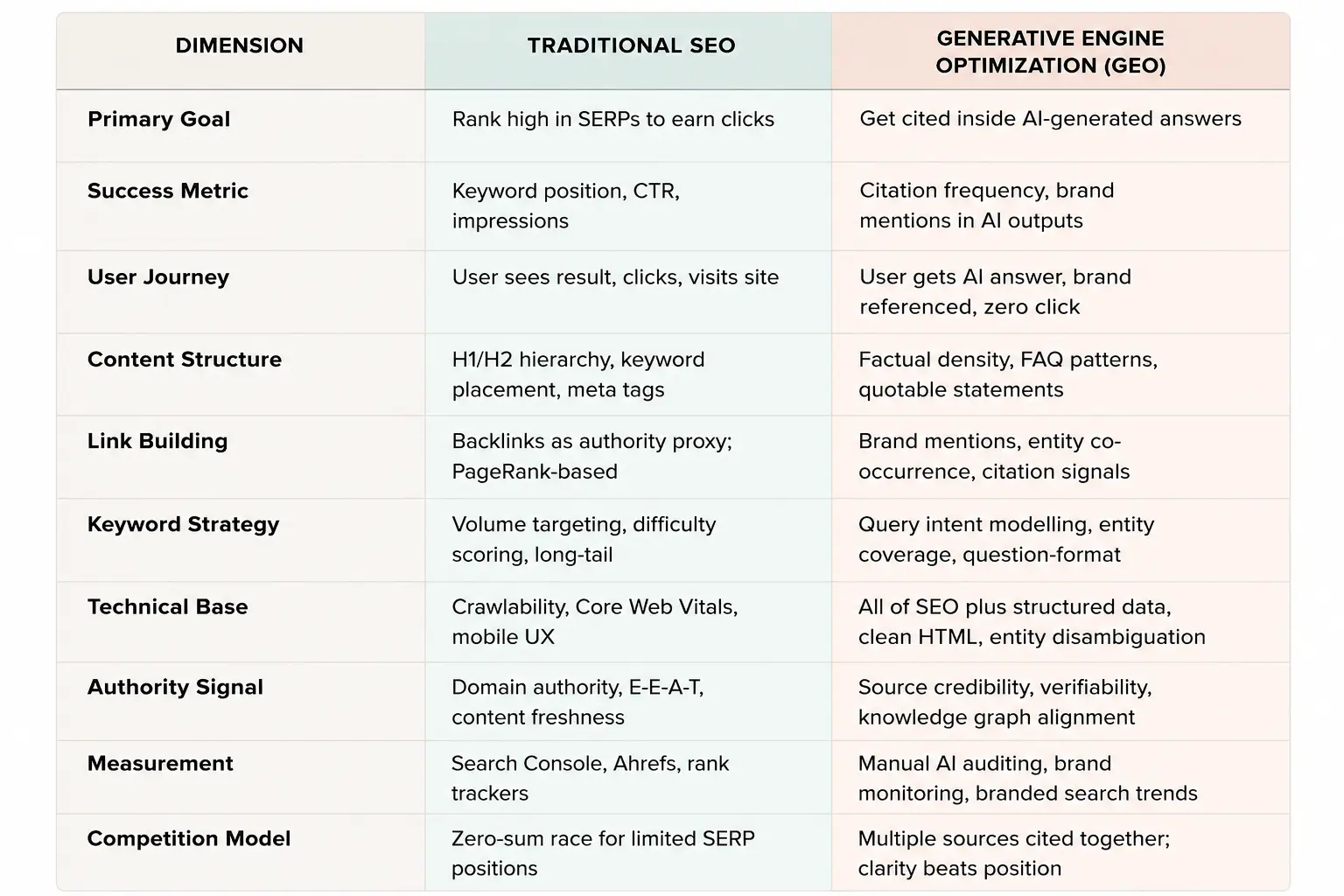
GEO vs Traditional SEO: A Full Comparison of Both Strategies
Side by side, the two disciplines differ across every major dimension from goals to measurement.
The instinct to map GEO onto existing SEO frameworks is natural but leads to miscalibrated strategies. The differences are not cosmetic. They reflect fundamentally different models of how users find information and what constitutes a win.
How to Optimize for AI Search: What GEO Content Actually Looks Like
Writing for generative AI citation is not about sounding robotic. It is about being structurally excellent.
One of the most persistent misconceptions about GEO for websites is that it requires producing dry, schema-heavy pages that sacrifice human readability. That is the opposite of what works.
Generative systems are trained on human writing at its best. They are not built to cite content that reads like an instruction manual. They cite content that is authoritative, specific, well-structured, and written with clear command over a subject.
Research from Princeton, Georgia Tech, and IIT Delhi, published in the paper that coined the term Generative Engine Optimization in late 2023, identified content characteristics that measurably increased citation frequency in AI responses.
6 Content Signals That Drive AI Search Citation Frequency
Factual density and specificity AI systems prefer specific, verifiable facts over generalities. "Email marketing delivers an average ROI of 42:1 according to the DMA" is dramatically more citation-worthy than "Email marketing has a great return on investment."
Authoritative sourcing Content that cites research studies, government data, named experts, or original surveys signals epistemic grounding to retrieval systems. AI systems will preferentially cite sources that themselves reference credible authorities.
Quotable, standalone sentences GEO content contains sentences that make complete sense in isolation. These are declarative, specific, and complete: sentences a generative model can lift and incorporate into a synthesised response without losing meaning.
FAQ and question-answer formatting AI systems are trained on query-response patterns. Content structured as questions with direct answers maps cleanly onto how generative engines process user queries. This is not merely a formatting tip. It changes how LLMs parse your content.
Entity completeness A page about real estate investment in Lahore should fully define its key entities: the type of real estate, the city segments involved, the investment timeframes, the risk factors. Entity completeness reduces ambiguity, and generative systems strongly favour unambiguous content.
Topical comprehensiveness A single well-structured article covering a topic from multiple angles, definition, mechanism, comparison, application, limitations, FAQs, is far more likely to be cited than a series of thin articles targeting individual keywords.
Schema Markup and Structured Data: The Technical Foundation of GEO
Schema is not just for rich snippets anymore. It is how AI systems resolve entity identity and source credibility.
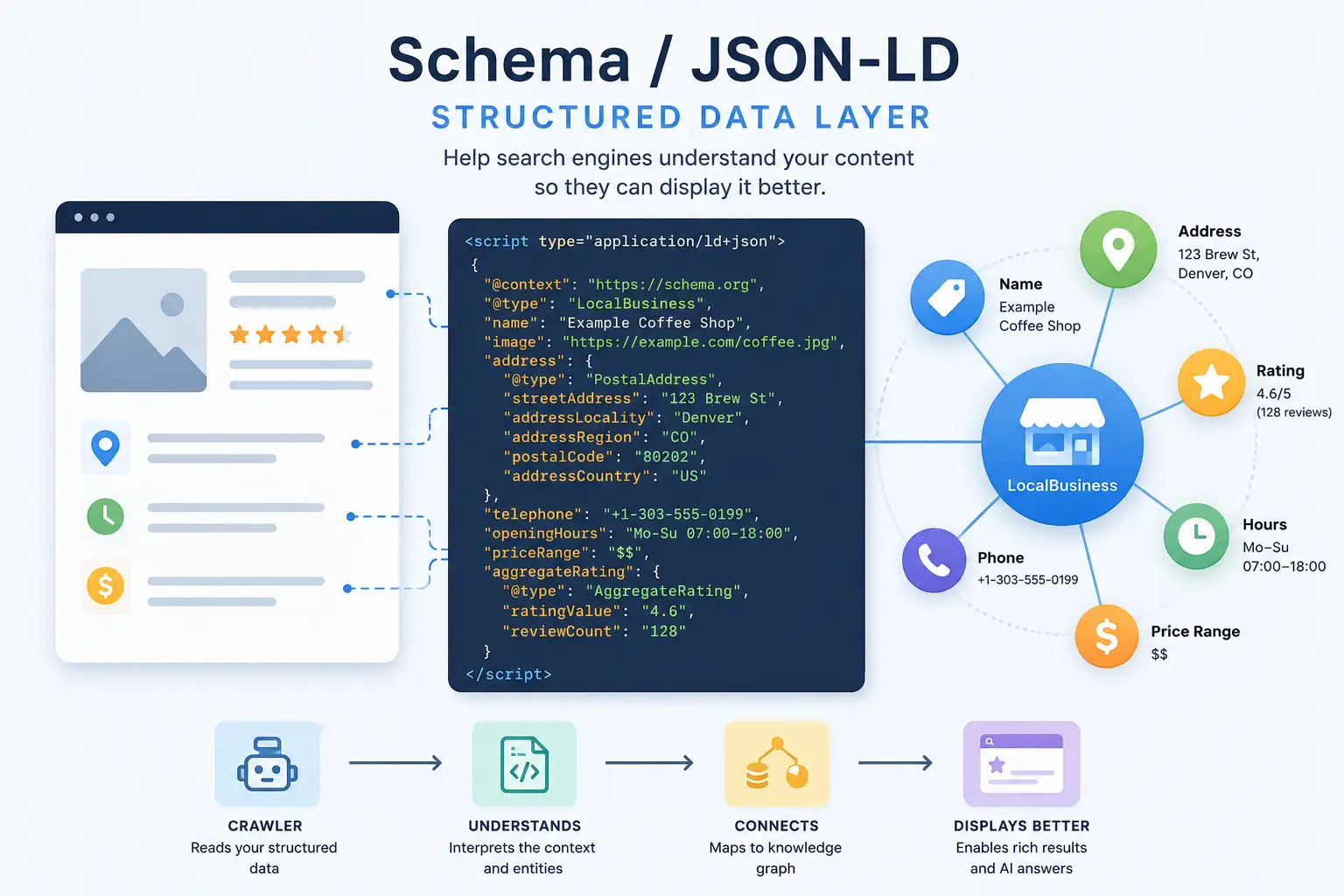
If GEO has a single non-negotiable technical foundation, it is structured data. Schema markup, the vocabulary of Schema applied via JSON-LD, functions as a direct communication channel between your content and the AI systems trying to understand it.
Traditional SEO recognised the value of schema for rich results: star ratings in SERPs, FAQ dropdowns, product panels. For GEO, schema serves a deeper function. It disambiguates entities, defines relationships, and provides semantic context that language models can reliably interpret.
GEO Schema Priority List
Highest-priority Schema.org types for GEO visibility: Article or Blog Posting with author, date Published, and publisher fully populated; FAQ Page with complete question-answer pairs; Organization with same As links to all official profiles; Product with complete attribute sets; and Local Business for any entity with a physical presence.
The same As property deserves special attention. It explicitly links your entity to its Wikidata, LinkedIn, and Google Business Profile identities, strengthening the Knowledge Graph associations that generative systems rely on for entity resolution.
GEO for Local Business and Niche Websites: The Hidden Advantage
Smaller, specialist brands often outperform large platforms in AI search because generative engines reward depth over breadth.

One of the biggest misunderstandings in the current GEO conversation is that optimizing for AI search engines is only relevant for large publishers or global brands. For smaller businesses in specific niches or geographies, GEO may actually be a more accessible competitive advantage than traditional SEO.
In traditional SEO, a furniture store in Karachi, a beauty products brand across Pakistani cities, or a construction company in Lahore compete against large e-commerce platforms with decade-long domain authority advantages.
In GEO, the terrain is different. A locally authoritative, entity-rich, schema-complete website that answers specific questions with verifiable expertise can appear in AI responses that major retailers miss entirely, precisely because those retailers' content is too generic to address hyper-specific local queries.
Applied Example: Fashion and Home Interior Brands
A fashion brand with a well-structured blog on how to choose sustainable fabrics for Pakistani summer clothing, complete with specific fabric names, certifications, and sourcing references, is far more likely to appear in a ChatGPT response about ethical fashion in Pakistan than a large international retailer whose blog on the same topic is written at a generic global level.
Specificity, local entity grounding, and factual density of niche expertise is what generative engines are searching for. This is the structural advantage smaller brands hold, if they write for it deliberately.
How to Measure GEO and Generative AI Search Visibility in 2025
GEO measurement is less mature than SEO measurement. Here is what practitioners are using right now.
Complete transparency is needed here: GEO measurement is, as of mid-2025, significantly less mature than traditional SEO measurement. There is no equivalent to Google Search Console for tracking AI citation frequency.
Manual auditing Systematically query ChatGPT, Perplexity, Google AI Overviews, and Microsoft Copilot for your target topics and record citation patterns. Time-intensive but currently the most reliable method.
Brand monitoring tools Platforms such as Mention and Brand24 are beginning to index mentions within AI-generated content. Coverage is still partial but improving rapidly.
Traffic signal analysis An increase in direct traffic, branded search queries, and dark social referrals may signal growing AI-generated visibility. Users encounter your brand in an AI response and then search for it directly afterward.
Perplexity citation logs Perplexity AI shows its source citations directly in the interface. Running systematic queries and tracking which domains appear in the citation panel is a practical, if manual, way to benchmark GEO performance.
GEO Content Strategy: Why SEO and Generative Engine Optimization Work Best Together
The technical foundations of SEO and the writing discipline of GEO are not separate programmes. They reinforce each other.
After examining what separates these two disciplines, it is worth stating clearly what they share, because abandoning traditional SEO for GEO, or treating GEO as irrelevant because SEO still drives traffic, are both equally damaging positions.
The technical foundations of SEO, fast crawlable pages, strong domain authority, logical information architecture, directly support GEO. A page that cannot be crawled cannot be cited. The E-E-A-T framework that Google uses to evaluate content quality maps almost precisely onto the authority signals that generative engines use to determine citability.
What GEO adds is a layer of intentionality about how content is constructed, not whether it exists. A well-optimised blog post that answers a specific question with factual depth, proper schema, named expert attribution, and clear entity relationships serves both a traditional search engine and a generative engine simultaneously.
The brands that will win are not those who chose between SEO and GEO. They are those who recognised that GEO is what SEO was always trying to be: content that is genuinely, verifiably, structurally excellent.
A 6-Step GEO Content Strategy to Optimize for AI Search Engines
Practical steps for integrating generative engine optimization into an existing SEO content operation.
Conduct a GEO visibility audit Before creating new content, audit current AI visibility. Query ChatGPT, Perplexity, and Google AI Overviews for your 20 to 30 most important topical queries. Note which competitors are cited, which content formats appear most often, and where your brand is absent.
Map content to query intent at the entity level Move beyond keyword-level planning. For each content piece, define the primary entity being addressed, the questions most commonly asked about it, and the verifiable facts that would make a definitive answer. Build briefs around entity completeness rather than keyword density.
Restructure existing cornerstone content for GEO High-value existing pages should be audited for GEO readiness. Add explicit FAQ sections with question-format headers and direct answers. Insert specific statistics with citations. Add JSON-LD schema. These retrofits often produce faster results than new content creation.
Build entity authority across the web Ensure your brand, key personnel, and products have consistent, complete profiles on Wikidata, LinkedIn, Google Business Profile, and industry directories. The sameAs schema connections must point to these live, accurate profiles.
Publish content designed to be quoted Introduce a quotable sentence discipline into your content workflow. Every substantive article should contain at least three to five sentences structurally designed to function as standalone citations: declarative, specific, complete, and attributable.
Monitor, measure, and iterate monthly Track which pages are being cited across AI platforms, monitor branded search volume trends as a proxy for AI-driven discovery, and iterate content based on what generative responses do and do not include from your domain.
Closing Perspective
Generative Engine Optimization is not a trend or a beta feature. It is the natural evolution of what search has always demanded from publishers:genuine expertise, clearly expressed, in service of the user's actual question.
Where Google once rewarded relevance and authority with a high ranking that users might click, AI systems now reward the same qualities with direct inclusion in the answer itself. The user may never visit your website. But if your brand is consistently cited as the authority in AI-generated responses about your category or geography, you are building something no algorithm update can take away: a reputation the machines trust.
That is the promise of GEO, and the reason every brand serious about generative AI search visibility needs to start building for it now, not after the shift has fully happened.
Frequently Asked Questions About Generative Engine Optimization

Answers to the most common questions about GEO SEO, AI search optimization, and how to get started.
Is GEO replacing traditional SEO, or should both run simultaneously?
GEO is not replacing SEO at this point, and the two should absolutely run together. The technical and content foundations of good SEO, crawlability, page speed, E-E-A-T signals, strong backlink profiles, are the same foundations that support GEO performance. A page that cannot be crawled cannot be cited by an AI system. What GEO adds is a specific layer of intentionality: writing with factual density, clear entity definitions, FAQ structures, and complete schema markup. Think of it as SEO with a GEO layer on top.
How do I track whether my content is being cited in AI-generated answers?
The honest answer is that measurement here is still developing. The most reliable method right now is manual auditing: query ChatGPT, Perplexity, Google AI Overviews, and Microsoft Copilot for your most important topical searches and look for your domain in the citations panel. Perplexity is particularly useful because it displays its source links openly. Brand monitoring tools like Mention and Brand24 are beginning to track AI citations, and watching branded search volume in Google Search Console for unexplained upward trends is a useful proxy signal for AI-driven discovery.
Does schema markup directly affect whether an AI system cites my content?
Yes, though the mechanism is indirect. Schema markup does not tell an AI model to cite you. What it does is help the AI system understand precisely what your content is about, who authored it, when it was published, and how your entities relate to each other. This reduces the ambiguity that causes generative systems to either ignore a source or misattribute it. JSON-LD structured data for Article, FAQPage, Organization, and LocalBusiness types, with the sameAs property pointing to active profiles on LinkedIn, Wikidata, and Google Business Profile, are the highest-value schema investments for GEO.
Can a small local business compete in GEO against large national websites?
In many cases, yes, and this is one of the more encouraging aspects of GEO. Large national platforms produce content at scale that is broad, generic, and optimised for high-volume national keywords. They rarely go deep on hyper-specific local topics. A construction company in Lahore that publishes genuinely authoritative, factually specific content about commercial fit-out regulations in Punjab, local material sourcing, or DHA approval processes has a real opportunity to be the source AI systems cite on those queries. Not because of domain authority, but because no one else has answered the question with that level of specificity. Niche depth beats generic breadth in GEO.
How often should I audit my GEO visibility and what should I look for?
A monthly cadence is practical for most businesses. In each audit, query your ten to twenty most important informational and comparison searches across ChatGPT, Perplexity, and Google AI Overviews. Record which sources are cited, whether your domain appears, and what content format those citations come from. Specifically look for patterns: are FAQ pages cited more than standard articles? Are competitors with more structured data appearing when yours are not? Are recent pieces being picked up or only older content? The audit findings should directly inform which pages to retrofit with better schema, richer FAQs, or more specific statistics in the following month's content work.