Local SEO Playbook 2026: Rank in the Map Pack and AI Results
Nearly half of everything typed into Google now has a local angle. Someone wants a plumber, a furniture showroom, a dentist, a real estate agent, and they want one close by, open now, and well reviewed. Industry data compiled for 2026 puts local intent at about 46 percent of all Google searches, up from roughly 30 percent in 2019. Near me searches alone run past 1.5 billion a month worldwide.
That traffic is not casual browsing. Around 76 percent of people who search for something nearby visit a business within a day, and about 28 percent of near me searches end in a purchase the same day. Local search is the shortest line between a search and a sale that exists online.
And most businesses are still losing it. Roughly 56 percent of Google Business Profiles are not fully filled in. That gap is your opening. Here is how to take it.
First, understand what you are actually ranking for
Local search has two results, and they are decided differently.
The first is the Map Pack: the box with three businesses, a map, star ratings, and a call button. It sits above the regular results on almost every local query. The second is the normal organic list underneath, where your website pages rank the usual way.
Most of the money is in the Map Pack. It gets the eye, the taps, and the calls. Around 68 percent of mobile users tap click to call straight from local results, which means plenty of customers never reach your website at all. Your Google Business Profile does the job your homepage used to do.
So the playbook has two tracks. Win the Map Pack through your profile, reviews, and local signals. Win the organic list through pages on your site. You need both, but if you only have time for one this quarter, start with the profile.
What decides the Map Pack
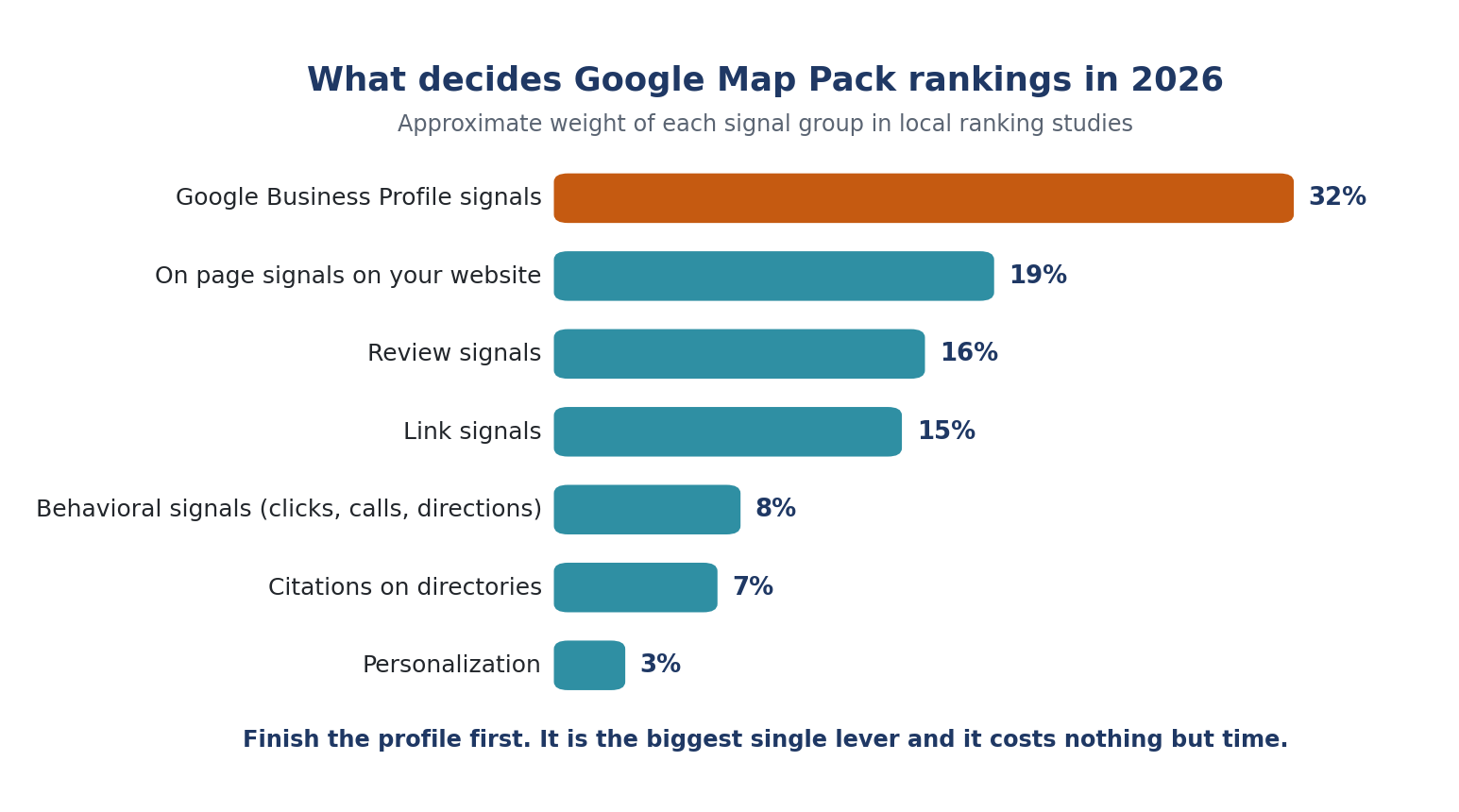
Local ranking studies for 2026 weight the signals roughly like this:
Google Business Profile signals: about 32 percent
On page signals from your website: about 19 percent
Review signals: about 16 percent
Link signals: about 15 percent
Behavioral signals like clicks, calls, and direction requests: about 8 percent
Citations on directories: about 7 percent
Personalization: about 3 percent
Read that list again and notice what is at the top. Your profile matters more than any other single thing. Businesses with a complete profile are about 2.8 times more likely to show up in the Map Pack than ones with gaps. That is the cheapest ranking lift in all of SEO, and it costs nothing but an afternoon.
Step 1: Finish your Google Business Profile properly
Open your profile and go through it like an inspector, not an owner. Every empty field is a signal you are handing to a competitor.
Pick the right primary category. This is the single most important field. “Furniture store” and “Home goods store” pull different searches. Choose the one that matches what you most want to be found for, then add secondary categories for the rest.
Write a full business description. Use the whole space. Say what you do, who you serve, and where. Profiles with complete service descriptions get about 35 percent more website clicks.
Fill in every service and product. Each one is a chance to match a search. A real estate agency should list buying, selling, rentals, and property management separately rather than one vague line.
Set accurate hours, including holidays. “Open now near me” searches grew about 900 percent since 2020. If your hours are wrong, you vanish from the queries that matter most.
Add real photos, and keep adding them. The top three local listings average around 250 photos, against fewer than 200 for positions four through ten. Shoot the storefront, the team, the work, the products. Stock photos tell Google nothing.
Post updates at least twice a month. Offers, new stock, a finished project, an event. Posts show the profile is alive, and an active profile beats a static one.
Turn on messaging and bookings if you can handle them. Behavioral signals count, and a profile that lets people act gets more actions.
Step 2: Build a review engine, not a review wish
Reviews are about 16 percent of the ranking picture and most of the conversion picture. Around 87 percent of consumers read reviews for local businesses, and roughly 49 percent will not consider a business under four stars. Businesses with 50 or more reviews get about 35 percent more Map Pack clicks, and about 62 percent of top three results carry 100 or more.
The mistake most owners make is hoping. Hoping customers remember, hoping they feel generous. Hope is not a system.
Build the ask into the job. When the project closes, the sale ships, or the appointment ends, there is a moment where the customer is happiest. Ask then. Send a short link to your review form by text or WhatsApp, not a long email that gets buried.
Make it easy. Google gives every profile a direct review link. Put it on receipts, on the invoice footer, on a small card at the counter.
Reply to every review, good and bad. Replies are visible to the next customer and they signal to Google that the profile is managed. A calm, specific reply to a bad review wins more trust than ten five star ratings with no response.
Never buy reviews or trade them for discounts. Google removes them, and a profile caught doing it can lose its listing. The slow way is the only way that lasts.
Step 3: Fix the local signals on your website
On page signals carry about 19 percent of the weight, and this is where many local businesses have nothing at all.
Build one page per location and one page per core service. A home interior company serving three cities needs three location pages, each with its own photos, its own copy, and the local phone number. One page that lists all three in a paragraph does not rank for any of them.
Put the city and the service in the page title and the main heading. “Kitchen renovation in Lahore” tells Google exactly which search to show it for. “Our services” tells it nothing.
Add LocalBusiness schema. This is structured data that spells out your name, address, phone, hours, and service area in a format search engines and AI assistants read directly. If you want the technical version of why this matters, our Technical GEO Playbook covers how machines read a page.
Embed your Google map and keep your name, address, and phone identical to your profile. Tiny mismatches, like “St.” on the site and “Street” on the profile, weaken trust between the two.
Make it fast on mobile. About 64 percent of local searches happen on phones, and roughly 53 percent of mobile users leave a site that takes more than three seconds. A beautiful site that loads slowly is an invisible site.
Step 4: Earn local links and citations
Links are about 15 percent and citations about 7 percent. Together that is more than reviews, and it is the part most local businesses never touch.
Citations are listings of your business on directories and industry sites. Get the major ones right first: the big general directories, then the ones specific to your trade. Consistency matters more than volume. Same name, same address, same phone, everywhere.
Local links come from being part of the place. Sponsor a local event and get listed on its page. Join the chamber of commerce. Get featured in a local news story or a neighborhood blog. Partner with complementary businesses, like a furniture store and an interior designer, and link to each other. One relevant local link is worth more than fifty random directory entries.
For the broader method, our guide to link building in 2026 goes deeper on earning links that hold up.
Step 5: Show up in AI local answers
This is the new layer, and it is where 2026 differs from every playbook before it.
When someone asks an AI assistant “who is a good interior designer near me” or “best furniture store in my area that delivers,” the assistant does not run a classic Map Pack. It pulls from what it can read and trust: your Google profile, your website, your reviews, and mentions of your business around the web. Then it names two or three options.
The good news is that the work above feeds this directly. A complete profile, consistent details, plenty of reviews with real text, and clear service pages give an AI assistant everything it needs to describe you confidently. The businesses that get left out are the ones with thin profiles and no written reviews, because the assistant has nothing to say about them.
Two extra moves help. First, make sure your reviews contain words, not just stars. A review that says “they refinished our dining table and delivered in four days” teaches an assistant what you do. Second, get mentioned in local roundups and “best of” lists, because assistants lean heavily on those when they recommend. If you want to measure whether this is working, our guide on auditing your brand’s visibility in ChatGPT and Gemini shows how to check.
A 20 minute local audit you can run today
Before you change anything, see where you stand. This takes twenty minutes and tells you what to fix first.
Search your main service plus your city in Google, in a private browser window so your own history does not color the result. Note who is in the Map Pack and where you are, if you are there at all.
Open the three profiles that won. Count their reviews, check their rating, count their photos, and look at when they last posted. That is your benchmark. You do not need to be the best business in town to rank. You need to be the best described one.
Open your own profile and compare line by line. Category, description, services, hours, photos, posts, reviews, questions answered. Every gap is a task.
Search your business name. Check that the name, address, and phone match on your website, your profile, and the first page of directory listings. Note any mismatch.
Load your website on your phone over mobile data, not office wifi. Time it. If it takes more than three seconds to become usable, speed goes to the top of the list.
Finally, ask an AI assistant the same question a customer would, something like “who is a good furniture store in my city that delivers.” See whether you are named and how you are described. If you are missing, the gaps you just found are almost always why.
Twenty minutes, and you have a ranked list of fixes instead of a vague worry.
A monthly local SEO routine
Local SEO is maintenance, not a launch. Here is a routine that keeps a profile climbing.
Every week: reply to new reviews, answer any questions on the profile, post one update.
Every month: add fresh photos, check hours and details are still right, review which searches brought people to the profile in the Insights tab, and ask for reviews from the month’s happiest customers.
Every quarter: audit citations for mismatches, check the location pages still load fast, look for two or three new local link opportunities, and run your main searches in Google and in an AI assistant to see where you stand.
Do that for six months and you will usually see the profile move from invisible to the Map Pack on your main terms. Do it for a year and you become hard to displace.
Frequently Asked Questions
How long does local SEO take to show results? Profile and review improvements often move rankings within four to eight weeks, because Google re reads the profile frequently. Website pages and local links take longer, typically three to six months. The fastest wins come from completing the Google Business Profile and building a steady flow of reviews.
What is the single most important local ranking factor? Your Google Business Profile. Profile signals carry about 32 percent of Map Pack ranking weight, more than any other category, and complete profiles are about 2.8 times more likely to appear in the Map Pack. Category choice, full details, photos, and regular posts are the core of it.
Do I need a separate page for each location? Yes, if you serve several areas and want to rank in each. One page per location, each with unique copy, photos, and the local phone number. A single page that lists every city rarely ranks for any of them.
How many Google reviews do I need? There is no fixed number, but the data points to a pattern. Businesses with 50 or more reviews get about 35 percent more Map Pack clicks, and roughly 62 percent of top three listings have over 100. Steady new reviews matter as much as the total, so build a repeatable way to ask.
How do AI assistants decide which local businesses to recommend? They read what they can trust: your Google profile, your website, reviews with real written detail, and mentions of your business on other sites and lists. The same work that wins the Map Pack feeds AI answers. Thin profiles and star only reviews give an assistant nothing to say, so those businesses get skipped.