AI Marketing for Small Business: Where to Start
If you run a small business, someone has probably told you that AI will change your marketing forever. Maybe you tried ChatGPT for a caption or two. Maybe you signed up for a tool that promised a month of posts in ten minutes, and now it sits unopened while your card still gets charged.
That second story is the one I hear most. The real risk with AI marketing for small business is rarely starting too late. It is starting with the wrong thing, paying for tools before you know what job they do, and ending up with content that sounds like everyone else.
This guide is the simpler route: where to begin, what AI is good at, what to keep human, a first month plan using free or low cost tools, and how to tell if it is paying off. It is written for owners in the US and Pakistan, but the logic works anywhere.
The short answer: start with one job, not ten tools
Pick one marketing task you repeat every week and give AI that single job for a month. Not your whole marketing. One job.
Good first jobs look like this:
Writing the first draft of your weekly email or newsletter
Turning one product or service into three social captions
Answering the ten questions customers ask most in a clear FAQ on your website
Summarizing last month's ad or sales numbers into three things worth acting on
Why only one? The real cost of AI tools for small business marketing is not the subscription. It is the hours spent setting up, learning tools, and fixing output that missed the point. One job keeps that cost small and the results easy to see. If it fails, you have lost a few hours, not months of fees.
Tools come last. Start with the assistant you already have, whether that is ChatGPT, Gemini, Claude, or the AI inside Canva or your email platform.
Where small businesses actually are with AI right now
You are not behind, and you are not alone. In Constant Contact's Q1 2026 Small Business Now survey of more than 1,500 owners across the US, UK, Canada, Australia, and New Zealand, 54 percent said they already use AI marketing tools and another 27 percent planned to start this year. The most common uses were analyzing trend data (45 percent), writing emails and other content (44 percent), and creating images (40 percent).
In the US the shift has been even faster. Constant Contact's June 2026 research found that AI use in small business marketing climbed from 26 percent in 2023 to 87 percent by April 2026. Across all the countries in that research, half of AI users said the main benefit was simply saving time.
So using AI is now normal. Getting real value from it is a different story.
A Goldman Sachs 10,000 Small Businesses survey released in March 2026 found that 76 percent of participants use AI, and 93 percent of those users report a positive impact. Yet only 14 percent say AI is fully built into their core operations, and 73 percent say they would benefit from more training and implementation help.
An earlier Reimagine Main Street survey with PayPal put a name on that middle group. It found that 51 percent of small businesses were "Explorers," trying AI tools without being fully committed. Among those Explorers, 34 percent did not yet see a clear use case or return, and 74 percent said clearer proof of return would get them to adopt.
That gap between trying AI and benefiting from it is where money gets wasted: tools bought before anyone picks a job for them, so nothing gets measured.
A note for owners in Pakistan
DataReportal's Digital 2026 Pakistan report counted 117 million internet users at the end of 2025, or 45.6 percent of the population, along with 79.9 million social media user identities. Your customers are online, and your competitors can use the same free AI tools you can.
Two things matter more here. A lot of selling happens in WhatsApp and Instagram messages, so drafting friendly replies to common questions may be a better first job than blog posts. And many customers switch between English, Urdu, and Roman Urdu. AI can draft in all three, but have a native speaker check anything that goes out, because tone in Urdu is easy to get wrong.
Four marketing jobs AI does well
1. First drafts
AI is very good at getting you past the blank page: captions, email drafts, product descriptions, blog outlines, sale announcements. The draft will not be finished, and that is fine. Editing a decent draft is much faster than writing from nothing.
Treat the output as raw material. Cut what sounds generic and add the detail only you know, like the customer who came back three times or the fabric that feels different in person.
2. Ideas and angles
Stuck on what to post this month? Give AI the last ten questions customers asked you and ask for twenty content ideas built around them. You will throw half away, and the other half will fill your calendar.
This works especially well for FAQ content, since the questions people ask you are the ones they type into Google and AI assistants.
3. Repurposing
One good blog post can become five pieces: a short email, three social posts, and a script for a 30 second video. AI does that reshaping quickly, which matters because social channels need a steady supply. In the same Constant Contact Q1 survey, 68 percent of owners expected social media to drive the most business this year.
If social is your main channel, see our guide to social media management for fashion and home decor brands and our roundup of AI video and design tools for social media.
4. Reading your numbers
Most owners have more data than time. Export last month's results from Meta, Google Analytics, your online store, or your email tool, paste them into an assistant, and ask plain questions. What changed since last month? What should I stop doing?
Always check the answer against the original numbers, because AI can misread a column or spot a trend that is not there. And remove customer names, phone numbers, and email addresses before you paste anything in.
The one page brand brief that fixes most bad AI content
If you remember one thing from this post, make it this. The biggest quality upgrade for any AI tool costs nothing: a short brand brief pasted at the top of every request, or saved in the tool's custom instructions or project settings so it is always there.
Without it, AI writes like an average of the whole internet. With it, the drafts start to sound like you. Keep it to one page:
Who you serve: one or two sentences about your best customers and what they care about.
What you sell: your main products or services, with price ranges if you share them publicly.
How you sound: three words for your voice, such as warm, direct, and practical.
Words you never use: the hype words and phrases that do not fit your brand.
What makes you different: three true facts, such as years in business or how things are made.
Proof: a couple of real reviews or results you are happy to reference.
The next step: whether you want readers to call, book, visit, or message you.
Review it every few months. For the full process from idea to published post, see our hybrid content workflow.
Three jobs to keep human
AI saves time on the work around your marketing. It should not replace the parts that make customers trust you.
Your point of view
Opinions, stories, and hard won lessons separate your business from the one down the road, and search engines seem to reward them. A Semrush study of 42,000 blog pages published in April 2026 found that human written content held the top Google position 80 percent of the time, compared with 9 percent for content classified as purely AI generated. In the same report, 70 percent of the content professionals surveyed named faster production as the main benefit of AI, but only 19 percent said it made their content better.
Google's own guidance on generative AI content agrees. AI written pages are not banned, but they face the same quality standards as any other page, and churning out pages that add nothing for readers counts as spam.
Speed is the win. Quality still comes from you.
Facts, prices, and claims
AI tools still make things up, and they do it confidently. They will invent a statistic, misstate your return policy, or promise a discount you never offered. Every number, price, date, and claim needs a human check before it goes out.
Be open about how you use it, too. Constant Contact's 2026 consumer research found that 46 percent of consumers want businesses to clearly label AI generated content. You do not need a disclaimer on every caption, but never pass off an AI image as a real photo of your shop or product.
Final approval
Give one named person the final say on everything AI helps produce, usually you or one trusted team member. A quick read before publishing catches the wrong price, the odd sentence, and the reply that sounds cold.
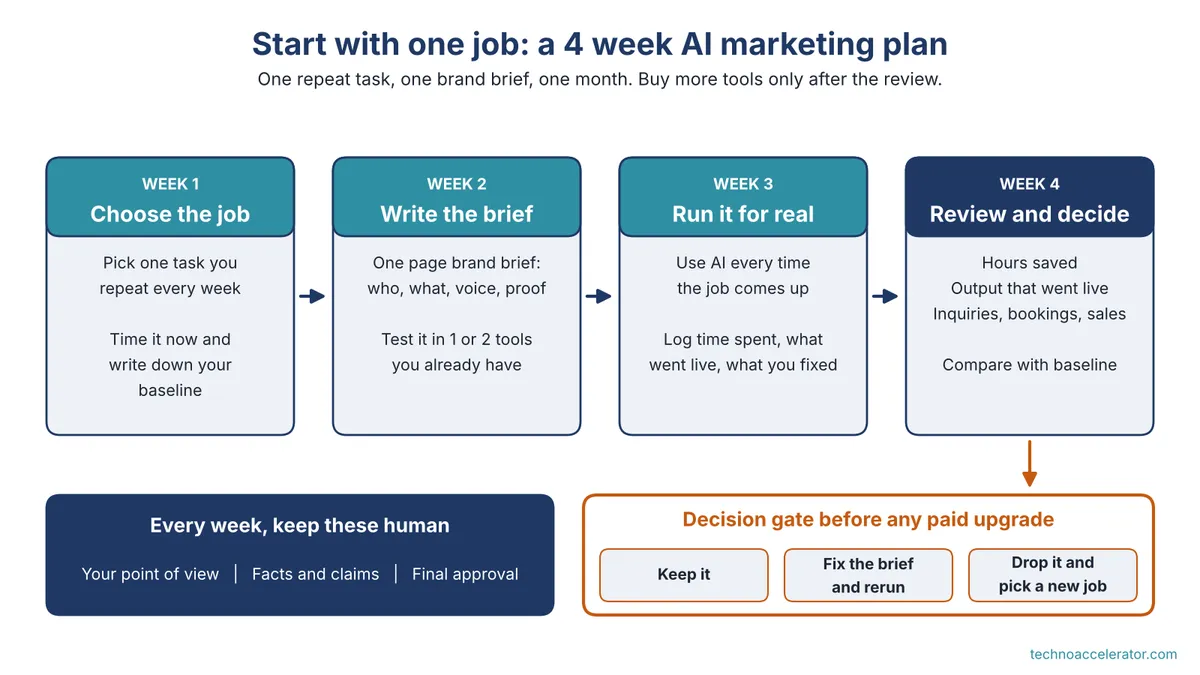
Your first month: a simple four week AI marketing plan
Here is how to start without wasting money. It needs a few hours a week and either free tools or one paid plan.
Week 1: Choose the job and time it
Pick one repeat task from the list above. Before you change anything, time how long it takes now and write it down. That is your baseline, and without it you will never know whether AI helped.
Week 2: Write the brand brief and test
Write your one page brief, then run the same task through one or two assistants you already have. Keep the tool whose draft needed the least fixing.
Week 3: Run it for real
Use AI for that job every time it comes up, from draft to published. Log what you made, how long it took, and what you had to fix, and save the prompts that worked.
Week 4: Review and decide
Compare your log with your baseline, then decide: keep the workflow, fix the brief and run another month, or drop the job and try another. Only then consider a paid upgrade, and only if the free version is clearly holding you back.
A few money rules for that first month:
No annual contracts until a tool has proved itself.
No tool that promises to run your whole marketing on autopilot.
Cancel anything nobody has opened in two weeks.
How to tell if AI marketing is worth it
Is AI marketing worth it? For most small businesses the honest answer is yes, as long as it is pointed at a clear job and measured. Track three things.
Hours saved. Compare your week 3 log with your week 1 baseline. If a job that took three hours now takes one, that is two hours back every week.
Output that actually went live. Drafts sitting in a folder do not count. Count the emails sent, posts published, and pages updated.
Business results. Watch the numbers that pay the bills: inquiries, bookings, email clicks, and sales from the channel you worked on. Give content a couple of months to build. Our guide on how to measure SEO ROI shows simple ways to connect content to revenue.
If you are not saving time after a month, or you are posting more while engagement falls, the tool is rarely the problem. Usually the job was too big, the brief was too thin, or nobody owned the review. Fix those before you shop for something new.
Do not forget AI search
Customers no longer just type into Google and scroll through links. They ask ChatGPT, Gemini, and Google's AI answers to recommend a business, and the reply is often a short list of names rather than a page of links. In February 2026, OpenAI said ChatGPT had more than 900 million weekly active users.
Social and search still matter too. In Constant Contact's 2026 consumer survey, 49 percent of consumers use social media to find new small businesses and 40 percent use search engines. AI assistants are one more door.
Two terms you will hear a lot. AEO, or answer engine optimization, means shaping your content so search features and AI assistants can lift a clear answer straight from it. GEO, or generative engine optimization, means giving AI tools enough trustworthy information about your business to mention you in the answers they write. Our posts on AEO versus traditional SEO and what GEO is and how it differs from SEO go into more detail.
The practical steps are refreshingly ordinary:
Give every main service its own clear page that says what you do, where, for whom, and roughly what it costs.
Answer real customer questions in plain language on an FAQ page, a sentence or two each.
Keep your business name, address, phone number, and hours the same everywhere, especially on your Google Business Profile. Our local SEO playbook for 2026 covers this step by step.
Ask happy customers for reviews that mention the service they used.
Add schema, a small block of code that labels your page for search engines, such as your business name, opening hours, or a question and its answer. Most website builders can add it for you.
Quick test: ask ChatGPT or Gemini for the best option for your service in your city. If you do not appear, our guide to auditing your brand's visibility in ChatGPT and Gemini shows what to check, and our AI answer box checklist covers how to format pages so they get quoted.
Use the time you save to be more personal
This is the part most AI marketing advice skips. The point of saving time is not to produce three times the content. It is to spend more of yourself where it counts.
People still choose small businesses for human reasons. Constant Contact's 2026 research found that the share of US consumers who prefer to shop mostly at small businesses rose from 10 percent in 2021 to 27 percent in 2026, with unique products and supporting the local economy among the main reasons. And when the company asked owners about the year ahead, their top marketing worry was not technology. It was customer engagement, named by 44 percent.
So put the hours AI gives back into things a tool cannot fake. Reply to reviews properly. Call a customer who has not been in for a while. Tuck a handwritten thank you note into a big order. Post a real photo from your shop floor. Those moments turn a first sale into a regular customer.
What to do next
Choose your one job this week, time it, and write your brand brief. That alone puts you ahead of most businesses that tried AI once and gave up.
If you would like help setting up the workflow, the brief, or your AI search basics, take a look at our services, or book a free call and we can talk through where AI fits in your marketing.
Frequently asked questions
What is the best way to start with AI marketing for a small business?
Start with one marketing task you repeat every week, such as email drafts or social captions. Time how long it takes now, write a one page brand brief, and use a free or existing AI assistant for that one job for four weeks. Then compare the time spent and the results before you add anything else.
How much should a small business spend on AI marketing tools?
In the first month, as little as possible. Free tiers or a single paid monthly plan are enough to test one job properly. Avoid annual contracts until a tool has shown that it saves you time or brings in business, and cancel anything nobody uses.
Is AI marketing worth it for a small business?
It usually is when it is pointed at a specific job and measured. Track hours saved, how much content actually went live, and business results such as inquiries, bookings, and sales. If none of those improve after a month or two, change the job or the brief before you buy a different tool.
Will AI written content hurt my Google rankings?
Google does not ban AI assisted content. It judges every page on quality and usefulness, and it treats mass produced pages that add nothing for readers as spam. Use AI for drafts and structure, then add your own experience and specific details, and check every fact before you publish.
Which AI tools for small business marketing should I try first?
Start with what you already have. A general assistant such as ChatGPT, Gemini, or Claude can handle drafts, ideas, and simple questions about your numbers, and many design and email platforms now include AI features in plans you may already pay for. Add a specialist tool only when a specific job clearly needs it.
Can AI marketing work for small businesses in Pakistan?
Yes. The same approach applies: one job, a clear brief, and human review. In Pakistan, useful first jobs often include drafting replies to common WhatsApp and Instagram questions and creating English and Urdu versions of posts. Have a native speaker review Urdu content, since AI can miss tone and cultural context.