SEO for Interior Designers and Home Decor Brands (2026)
Most interior designers get their clients the same way they did twenty years ago: a happy client tells a friend. One industry survey found roughly eight in ten designers do little or no structured marketing beyond referrals. That works until it does not. A slow quarter, a move to a new city, a competitor who shows up first on Google, and the referral well runs dry.
Meanwhile the people who need you are searching. “Interior designer near me.” “Small living room ideas.” “How much does an interior designer cost.” They are searching on Google, on Google Images, on Pinterest, and increasingly by asking an AI assistant. If you are not in those results, someone else is getting the call.
This is a playbook for designers, decor brands, and furniture studios who want search to bring clients, not just referrals. It is built around how this specific market actually searches, which is more visual and more local than almost any other.
How people search for design, and why it changes everything
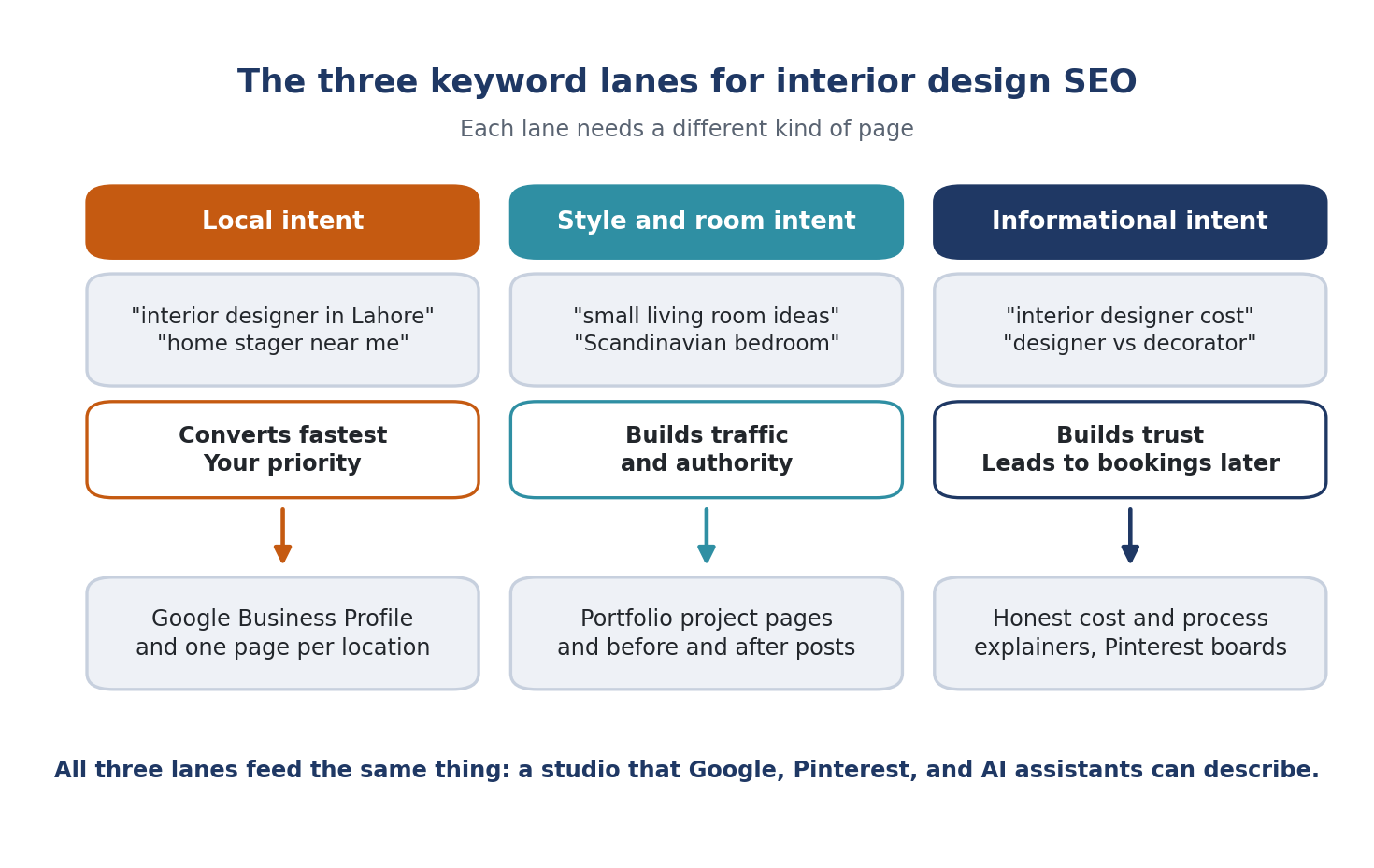
Interior design search runs in three lanes, and each one does a different job.
Local intent: “interior designer in Karachi,” “home stager near me,” “kitchen designer Lahore.” These searches come from people ready to hire, and they convert fastest. They are your priority.
Style and room intent: “Scandinavian bedroom ideas,” “small apartment living room layout,” “mid century modern dining room.” These bring far more traffic, but the searcher is dreaming, not hiring, at least not yet. They build awareness and topical authority.
Informational intent: “interior designer vs decorator,” “how much does an interior designer cost,” “what to expect from a design consultation.” These build trust. People bookmark them, come back, and eventually call.
The mistake is treating all three the same. Local pages should be built to convert. Style content should be built to be found and shared. Informational content should be built to answer honestly and point to a consultation. Different lanes, different pages.
Step 1: Your Google Business Profile is your best salesperson
For a design business, the profile matters more than the website. Profile signals carry about 32 percent of local ranking weight, more than any other single category, and complete profiles earn around seven times more clicks than incomplete ones.
Choose the right category. “Interior designer” for a design practice, “Furniture store” or “Home goods store” for retail, and add the others as secondary categories.
Upload real project photos, and keep uploading. Design is visual, and the top three local listings average around 250 photos. Every finished room is a reason to add five more. Name the files descriptively before you upload them.
Post at least twice a month. A finished project, a before and after, a new collection, a seasonal tip. Posts keep the profile alive and give you something to show in the Map Pack beyond a star rating.
Collect reviews that say something. “Beautiful work” is nice. “They redesigned our open plan living and dining area, sourced everything within budget, and finished in six weeks” is a sales pitch written by a customer. Ask clients to mention the room, the style, and the result.
For the full local method, our 2026 local SEO playbook goes deeper on the Map Pack and on how AI assistants choose local businesses.
Step 2: Build one page per place you serve
A design studio serving three cities with one generic services page will not rank in any of them. Build a page for each city or neighborhood you work in.
Each page needs its own copy, not the same paragraph with the city swapped. Describe the kind of homes and projects you do there, the local style you see, the neighborhoods you have worked in. Add project photos from that area. Put the city and the service in the page title and the main heading. Include the local phone number and embed your map.
This is the single highest return page type for a service based design business, because it matches the searches that come from people ready to hire.
Step 3: Turn your portfolio into a search asset
Most portfolios are beautiful and invisible. A gallery of unlabeled images is nothing to a search engine.
Give every portfolio project its own page with a real title, like “Coastal three bedroom renovation in Clifton,” not “Project 14.” Write 200 to 400 words about the brief, the challenge, the solution, and the materials. Clients read this. So does Google.
Every image needs descriptive alt text and a meaningful file name. “Walnut and brass kitchen island with pendant lighting” is alt text that can rank in Google Images. “Untitled” cannot. Google Images drives a meaningful share of all searches, and design is one of the most image searched categories there is.
Compress every photo and use modern web formats. Photo heavy sites are slow by default, and slow sites lose rankings and visitors. Lazy load images below the fold so the page shows quickly.
Add before and after sets wherever you can. They are the most shared, most linked, and most convincing content a designer can publish.
Step 4: Treat Pinterest as a search engine, not a mood board
For home decor, Pinterest is a second Google. “Living room ideas” is among the most searched terms on the platform in the US, interior design searches there climb around 180 percent every autumn, and it reaches roughly a third of American adults. Plenty of design clients start their search there months before they ever type anything into Google.
The mistake designers make is treating Pinterest as a place to mirror the portfolio. It is a search engine with its own rules.
Write keyword rich pin titles and descriptions. “Small apartment living room with built in storage, Scandinavian style” will be found. “Living room” will not.
Organize boards by room and by style, because that is how people search there.
Link every pin back to the matching project page or service page on your site. A pin without a link is a compliment. A pin with a link is a lead source.
Pin consistently, including older projects. Pinterest content keeps surfacing for months, unlike social posts that die in a day.
Step 5: Write the content clients search for
Three types of content work unusually well in this market.
Before and after case studies. Walk through the project room by room: what the client wanted, what was wrong, what you changed, what it cost in rough terms. These rank for style terms, earn links, and close clients.
Material and sourcing breakdowns. “Where we sourced the marble for this bathroom” or “why we chose engineered wood over solid.” Specific, expert, and the kind of thing nobody else publishes.
Honest cost and process explainers. “What an interior designer costs in Pakistan in 2026” or “what happens in a design consultation.” These answer the questions people are afraid to ask, and they are exactly what AI assistants pull from when someone asks the same thing.
Tie everything to your name and your city. A generic “ten bedroom ideas” post competes with the whole internet. “Ten bedroom ideas from our Lahore projects” competes with nobody.
Step 6: Earn the links that matter in design
Link building for designers is about belonging to the industry, not volume.
Get listed in local business directories and the chamber of commerce. Pitch your projects to design publications and local lifestyle magazines, which love before and after stories with good photography. Write guest pieces for complementary businesses: architects, real estate agents, home stagers, furniture retailers. Ask the brands you specify to list you on their dealer or designer pages. One link from a respected design publication outweighs fifty directory entries.
Our guide to link building in 2026 covers the wider method, including how to turn mentions of your studio into links.
Show up when someone asks an AI assistant
More clients now ask an assistant “who is a good interior designer in my area” or “what does a kitchen redesign cost.” The assistant answers from what it can read: your profile, your project pages, reviews with real detail, and mentions of your studio on other sites. The work above feeds all of it. A designer with a complete profile, written reviews, labeled project pages, and a few press mentions gets recommended. One with a gallery of unlabeled photos does not, because the assistant has nothing to say.
If you want to check where you stand, our guide to auditing your brand’s visibility in ChatGPT and Gemini shows how.
If you also sell: decor and furniture brands
Many design businesses also sell, and many furniture and decor brands also offer design services. If that is you, there is a second set of pages to get right: your products and collections.
Every product needs its own written description, not the supplier’s. A lamp described in your words, with the room it suits and the materials it is made from, outranks the same lamp pasted onto forty other stores. Collections like “small space sofas” or “brass lighting” deserve a short written introduction, because those are the pages that rank for the broad terms people search when they start shopping. Product photos need the same alt text discipline as portfolio photos, and product schema needs to show price, availability, and reviews so your listings earn stars in search results.
Our ecommerce SEO guide covers the store side in full, including how to stop filters from creating thousands of duplicate pages. The design content and the product pages feed each other: a room reveal links to the pieces in it, and a product page links to the rooms it has appeared in. That loop is something a pure retailer cannot copy, and it is one of the strongest advantages a design led brand has.
A 90 day starter plan
Weeks one and two: finish the Google Business Profile completely, upload thirty labeled project photos, set a review request into your project closing process.
Weeks three to six: build one page per location you serve, and give your five best projects proper pages with titles, write ups, and alt text.
Weeks seven to ten: set up Pinterest boards by room and style, pin every project with keyword rich titles linked to the project pages, and publish two before and after case studies.
Weeks eleven to thirteen: pitch one project to a local lifestyle publication, claim your listings in industry directories, and run your main searches in Google and in an AI assistant to see what has moved.
That is a full quarter of work, none of it technical, and it puts most design businesses ahead of every competitor who is still waiting for referrals.
The mistakes that keep designers invisible
Neglecting the Google profile while spending on the website. The profile wins the local search.
Uploading portfolio photos with no alt text and no project write up. Beautiful and unfindable.
Publishing generic room idea posts with no local angle and no project behind them.
Treating Pinterest as a portfolio mirror instead of a search channel.
Chasing link volume from low quality directories instead of a few real industry links.
Ignoring page speed on a photo heavy site.
What to expect, and when
Profile and local work usually shows early movement within four to eight weeks. Portfolio pages, content, and links take three to six months to change rankings meaningfully. The payoff is a client pipeline that does not depend on who happened to mention you at dinner last week.
Frequently Asked Questions
What keywords should an interior designer target? Three kinds. Local keywords like “interior designer in [city]” come first because they convert fastest. Style and room keywords like “small living room ideas” build traffic and authority. Informational keywords like “how much does an interior designer cost” build trust. Each needs its own type of page.
Does Pinterest help interior design SEO? Yes, as its own search engine. Keyword rich pin titles and descriptions, boards organized by room and style, and pins linked back to project pages bring traffic that keeps surfacing for months. It also sends people to your site and raises your brand mentions, which helps Google and AI assistants.
How do I make my portfolio rank? Give each project its own page with a descriptive title and 200 to 400 words about the brief, challenge, and solution. Add descriptive alt text and file names to every image, compress photos, and include before and after sets. A gallery of unlabeled images cannot rank.
Do I need a page for every city I serve? Yes, if you want to rank in each one. Each location page needs its own copy, local project photos, the city and service in the title, and the local phone number. One generic services page rarely ranks anywhere.
How long does SEO take for an interior design business? Google profile and local improvements often show movement in four to eight weeks. Portfolio pages, content, and links usually take three to six months to affect rankings meaningfully.