Link Building in 2026: Backlinks and Brand Mentions
Ask ten people in SEO whether links still matter and you will get ten confident answers, half of them wrong. Some say links are dead. Some run the same mass outreach they ran in 2015 and wonder why nothing moves.
Here is where things actually stand. Links still count. Google still uses them, and in local search alone they carry around 15 percent of ranking weight. But the kind of link that counts has narrowed sharply, and a second signal has grown up beside it: the plain mention of your brand, with or without a link, across the web. In 2026 the two work together, and they feed something new, which is whether an AI assistant names you when someone asks for a recommendation.
This guide covers what earns links now, what gets sites penalized, and how to build mentions and links as one effort instead of two.
Why the game changed
Three things happened between the old playbook and now.
Google got much better at spotting patterns. Networks of sites built only to pass links, articles that exist only to hold a link, and hundreds of near identical directory entries all look like what they are. The sites still running those plays are quietly losing ground, and some are losing it loudly through manual penalties that can wipe out years of work in a week.
Google formally went after borrowed authority. Since the March 2024 spam update, publishing third party content on a trusted site mainly to ride that site’s rankings is treated as abuse. That closed a lot of paid “guest post” placements on big publications overnight.
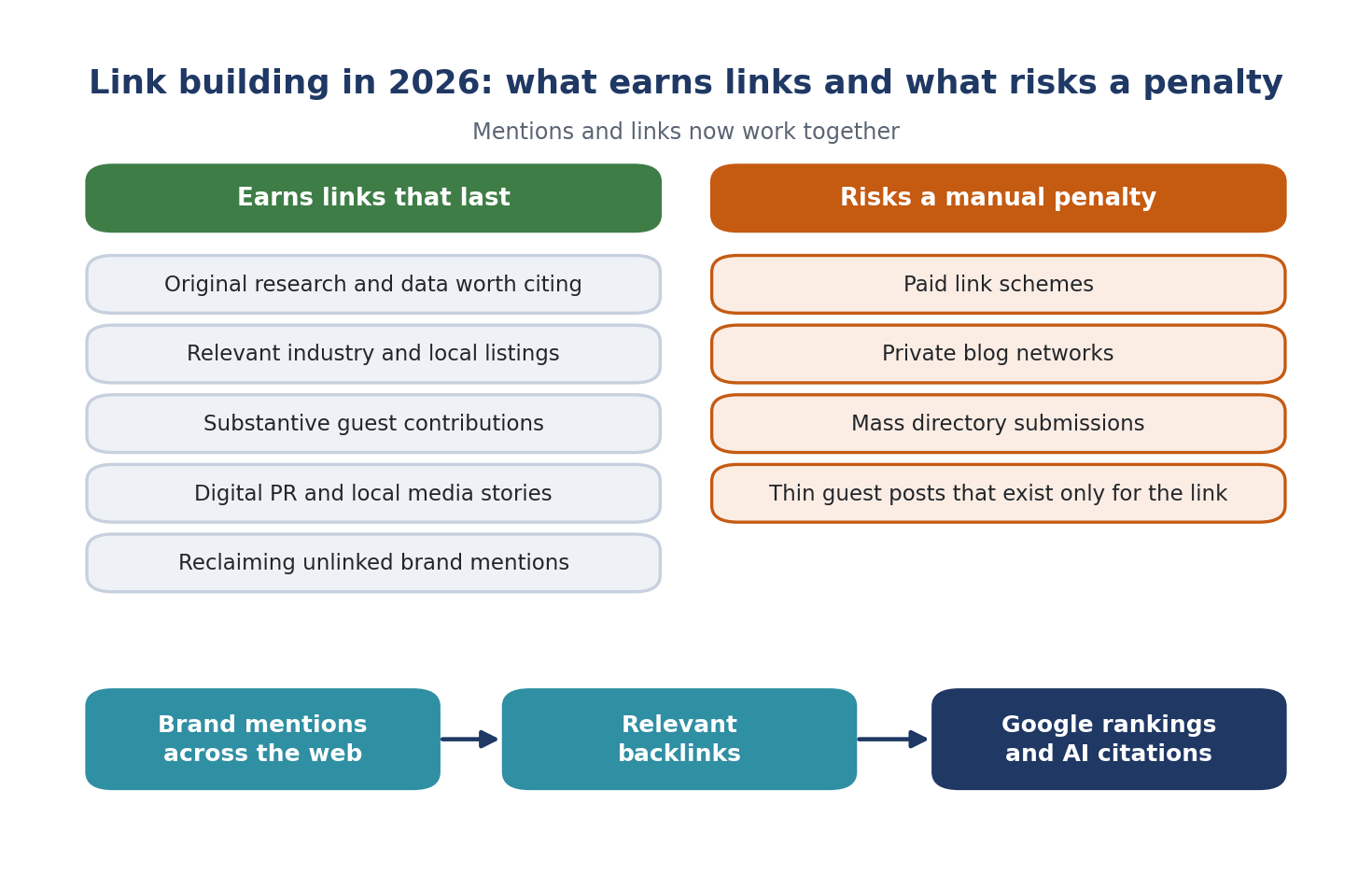
And AI search arrived. When ChatGPT, Gemini, or Perplexity recommend a business, they lean on what they have seen said about that business across the web. Research through 2025 found that mentions of a brand were the strongest single link to AI visibility, ahead of backlinks. Links still help, but being named, described, and recommended on other sites is now its own ranking currency.
So the goal is no longer “get links.” It is “become a brand that other sites talk about,” and collect the links that come with that.
What earns links in 2026
Content worth citing
The oldest advice is still the best. If your page answers a question better than anything else available, other sites link to it without being asked. What has changed is what “better” means. Original research, your own data, a survey of your customers, a benchmark you ran, a comprehensive guide that saves someone an afternoon. Opinion pieces and rewritten summaries do not earn links. Something new does.
An agency might publish what it learned auditing fifty local businesses. A furniture retailer might publish real delivery times by city. A real estate firm might publish a yearly price map. Each of those is a reason for a journalist, a blogger, or a competitor to cite you.
Relevant industry listings
Directories are not dead, but random directories are. A listing on your trade association’s site, your chamber of commerce, a respected industry body, or a well known regional business list carries weight. A listing on a generic “submit your site” directory carries nothing and, in volume, carries risk. Relevance is the whole test.
Guest contributions that are actually good
Guest posting still works when the piece is substantive, written for the host’s readers, and placed on a site that genuinely covers your field. A thoughtful article for a regional business publication or a respected trade blog earns a contextual link and puts your name in front of the right people.
What no longer works is thin content written only to hold a link, on sites that will publish anything for a fee. That is exactly what the site reputation abuse policy targets. We run a guest contribution program across a verified set of real platforms for this reason, and the rule is simple: if the article would not be worth publishing without the link, it is not worth publishing.
Digital PR and local media
Journalists need stories. Give them one. A data study, an expert quote on a trend, a local angle on a national story, a notable project, a charity partnership. These earn editorial links from news and magazine sites that are almost impossible to get any other way, and they generate exactly the brand mentions that AI assistants read.
For local businesses this is easier than it sounds. Local news sites and community blogs are hungry for stories about local businesses doing something. A new showroom, a milestone, an event, a hire, a renovation. Our local SEO playbook covers how these local mentions feed the Map Pack too.
Reclaiming mentions you already have
This is the highest return tactic most businesses never run. Somewhere on the web, people are already mentioning your brand without linking to it. A review roundup, a forum thread, a blog that named you in passing, a supplier that listed you as a client.
Find those mentions with a brand monitoring tool or a careful search, then send a short, friendly note asking if they would add a link. The conversion rate is typically strong, because the site already chose to mention you. You are not asking for a favor from a stranger. You are asking someone who already likes you to make one small edit.
What to stop doing
Paid link schemes. Buying links that pass ranking signals is against Google’s rules, and it is detectable. The risk is a manual penalty that undoes real work.
Private blog networks. Groups of sites that exist only to link to each other are the most recognizable pattern in SEO. They do not last.
Mass directory submissions. Hundreds of low quality listings do not add up to one good one. They add up to a footprint that looks manufactured.
Link exchanges at scale. A natural partnership link between two related businesses is fine. A spreadsheet of reciprocal links is not.
Any guest post where the article is an afterthought. If the link is the point, the piece will read like it, and the host site is probably the kind that gets caught.
A handful of real links from authoritative, relevant sources beats hundreds of weak ones. That has been true for years. The difference now is that the weak ones can actively hurt.
Mentions and links as one strategy
The practical shift for 2026 is to stop running link building as a separate task and run it as reputation building that produces links.
Every piece of original research is a link magnet and a mention magnet. Every press story earns a link and teaches AI assistants who you are. Every guest article puts your name in a new place. Every reclaimed mention becomes a link. Every local sponsorship is a citation, a link, and a mention at once.
Measure both. Track referring domains, and track brand mentions, including unlinked ones. Watch whether your brand gets named when you ask an AI assistant about your category. Our guide to auditing your brand’s visibility in ChatGPT and Gemini walks through exactly how to run that check. If mentions climb and AI visibility follows, the strategy is working even in months where the link count barely moves.
How to pitch a story that gets covered
Digital PR fails for one reason more than any other: the pitch is about the business, not about the reader. A journalist does not care that you launched a service. They care whether their readers will.
Start with the angle. What is surprising, useful, local, timely, or human about what you have? A furniture store opening is not a story. A furniture store that tracked delivery times across the city and found which neighborhoods wait longest is a story. A design studio is not a story. A design studio that renovated a hundred year old house and documented every surprise behind the walls is a story.
Keep the pitch short. Three or four sentences. Who you are in one line, the angle in two, and an offer of photos, data, or an interview. Put the angle in the subject line.
Pick the right outlets. Local news, regional business publications, trade magazines in your field, and the blogs your customers actually read. A placement in a small, relevant publication beats a rejection from a large, irrelevant one.
Follow up once, a week later, politely. Then move on.
Finding and reclaiming mentions, step by step
Search your brand name in quotes, then your brand name with your founder’s name, your main product names, and any common misspellings. Scan the first few pages of results and note every site that names you.
Use a brand monitoring tool to catch new mentions as they appear. Several free and low cost tools send an alert when your name shows up somewhere new.
For each mention, check whether it links to you. If it does not, find the author’s contact, and write two lines. Thank them for the mention, and ask whether they would be willing to link the brand name to your site so readers can find you. Offer the exact URL.
Keep a simple sheet of mentions, whether they are linked, who you contacted, and when. Review it monthly. Over a year, this one habit typically produces more real links than any outreach campaign, at almost no cost, with zero risk.
A monthly link and mention routine
Here is a routine a small team can actually sustain.
Each month, publish or update one piece of content designed to be cited: a data point, a study, a definitive guide.
Each month, pitch two stories to relevant media or trade publications, and write one substantive guest piece for a site that fits.
Each month, search for new unlinked mentions and send polite reclaim requests.
Each quarter, review your industry and local listings for gaps and inconsistencies, and look for one or two partnership or sponsorship opportunities.
That cadence produces a steady flow of real links and real mentions, builds the kind of footprint Google and AI assistants trust, and never puts the site at risk.
Frequently Asked Questions
Do backlinks still matter for SEO in 2026? Yes. Google still uses links, and in local search they carry around 15 percent of ranking weight. What changed is which links count. Relevant, editorial links from real sites help. Paid, networked, and mass directory links do not, and can trigger penalties.
What are brand mentions and why do they matter? A brand mention is any time your business is named on another site, with or without a link. Research through 2025 found mentions were the strongest single signal linked to AI search visibility, ahead of backlinks. AI assistants recommend brands they see described across the web, so mentions now matter alongside links.
Is guest posting still safe? Yes, when the article is genuinely good, written for the host’s readers, and placed on a relevant site. It is not safe when the piece is thin and exists only to carry a link, especially on sites that publish anything for a fee. That is what Google’s site reputation abuse policy targets.
What is the easiest link building win? Reclaiming unlinked mentions. Find sites that already name your brand without linking, and ask them to add a link. Conversion is usually strong because they already chose to mention you.
How many links do I need? There is no number. A few links from authoritative, relevant sources outweigh hundreds of weak ones, and weak links in volume can hurt. Focus on a steady monthly flow of real links and mentions rather than a target count.