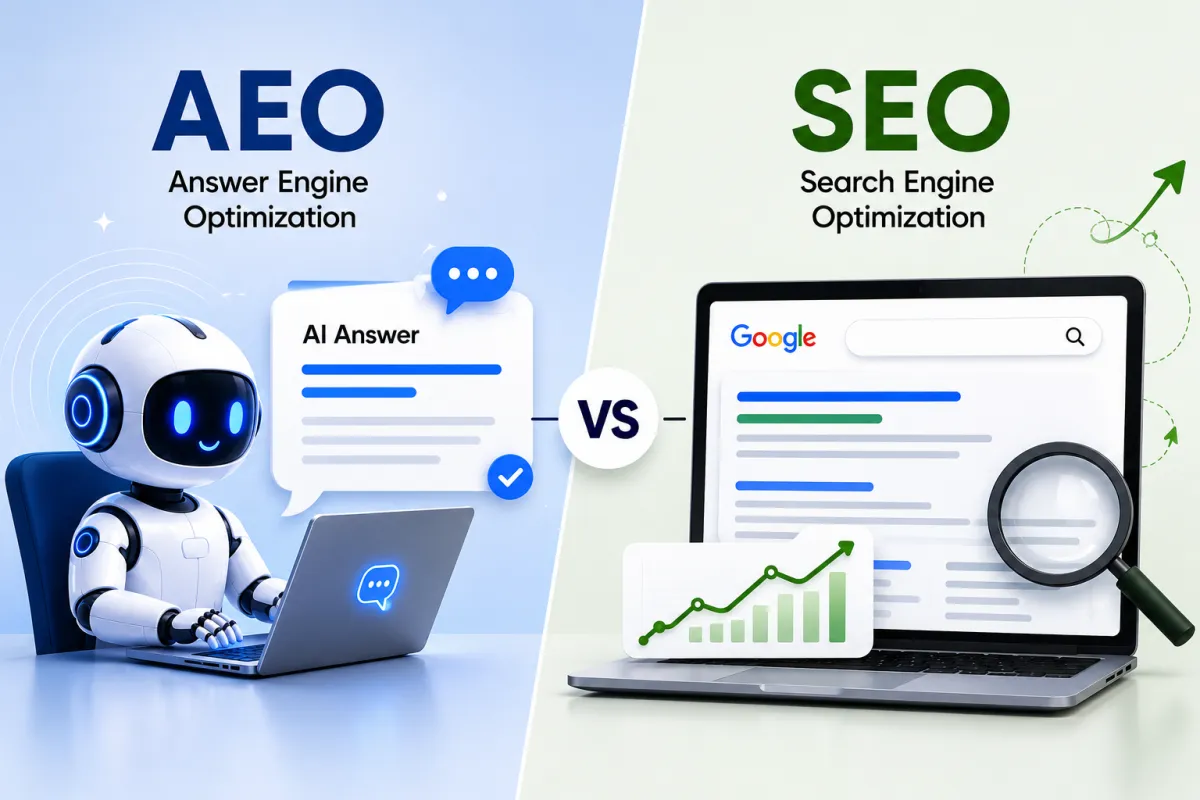
AEO vs Traditional SEO: Which Is Better for E-Commerce Sites?
In This Article
1. What Traditional SEO Actually Does for E-Commerce
2. What AEO Does Differently
3. Where the Two Strategies Part Ways
4. What This Means for E-Commerce Sites Right Now
5. How Techno Accelerator Approaches This
6. Frequently Asked Questions
Five years ago, search was simple. You typed something into Google and clicked a result. That was it. Today a customer shopping for a sofa might type "leather sectional sofa under 80,000 PKR" into Google, then turn around and ask Alexa the same question in a different way, then open ChatGPT before bed to ask which furniture brands actually deliver for free. Same person. Three different platforms. Three completely different answers serving her at each step.
That reality is putting e-commerce businesses in a difficult spot. Traditional SEO built the foundation most online stores still depend on. But Answer Engine Optimisation, AEO, is picking up a type of search intent that keyword rankings were never designed to capture. Understanding the difference is not optional anymore. Acting on it is the part most brands keep putting off.
What Traditional SEO Actually Does for E-Commerce
The whole point of traditional SEO is a click. Rank the page, earn the click, convert the visitor. For e-commerce this means building product pages, category pages and blog content around keywords that signal buying intent. Things like "buy running shoes online," "best moisturiser for oily skin," or "wooden dining table Lahore."
The work itself is less exciting than it sounds. Technical SEO keeps the site fast and crawlable. On-page work gets title tags, headings and body copy aligned with the terms people actually search. Backlinks build domain authority over time. Local SEO handles the geographic side. Content builds topical depth. Pull any one of these out and the others work harder to compensate.
What justifies the investment is how it compounds. A category page earning a page-one ranking keeps pulling traffic long after the work is done. Ranking for "bedroom furniture Lahore" in month three is still paying in month eighteen without a single rupee in ad spend behind it.
There is a ceiling though. Traditional SEO puts a result in front of someone and hopes they pick it. What it was never built to do is place your answer directly inside the search experience itself. And that is exactly where more and more queries are finishing these days.
What AEO Does Differently
AEO is not about ranking. It is about being the answer that gets read.
Answer Engine Optimisation structures content so AI platforms can pull it and serve it as a direct response to what someone asked. Google AI Overviews, ChatGPT, Perplexity, Bing Copilot, voice assistants, all of them work this way. No click needed. No list of results to scroll through. Just a response, credited to whichever source the platform decided was credible enough to trust.
The mechanics here are genuinely different from a standard SEO checklist. Structured data and schema markup are not optional, they give AI systems a machine-readable version of what a page actually says. FAQ sections, direct definitions, comparison content: these are the formats AI engines were built to extract from. Entity signals matter as well. AI platforms want to understand who a brand is, what it sells, where it operates and whether outside sources back up its authority. Keyword density barely registers in that calculation.
Think about what this looks like on the ground. Someone asks "which furniture store in Karachi offers free assembly" and they are not opening ten browser tabs. They read one synthesised response and move on. If your store is not named in that response, you simply do not exist for that moment of intent. Not buried on page two. Just absent.
Where the Two Strategies Part Ways
They are not fighting each other. Worth saying that clearly before anything else.
Traditional SEO owns the transactional end of search. When someone types "buy dining chair online" they expect a results page with options to browse and compare. Organic rankings still drive the majority of direct e-commerce revenue and that is not changing soon. No serious online store is scrapping keyword strategy, link building and technical health to chase AEO citations. That would be like gutting the structural foundations of a building to fit a better roof.
AEO covers a different window in the buying process, the research stage. "Is Italian marble flooring worth the price?" "What thread count actually holds up for hotel-quality sheets?" "Ceramic or porcelain tiles for a bathroom, which one lasts?" These questions land before any purchasing decision gets made. A brand that shows up inside an AI-generated answer at that moment is building name recognition and trust before the buyer has even considered clicking anything.
The practical gap between running both is real. Traditional SEO work is organised around pages: fix this URL, build links to that category, sort the crawl errors on those product pages. AEO work is organised around questions: what is your customer actually asking, on which platform, and does your content answer it with enough clarity that a machine selects it over a competitor? The content architecture is different. The schema implementation is different. The way you measure success is different.
What This Means for E-Commerce Sites Right Now
Neither approach is optional at this point. Treating them as a choice between one or the other is how you end up invisible across half the search landscape.
Traditional SEO is still where the volume sits. Category pages, product pages and collection-level content need to rank for commercial keywords. Site speed, crawlability, backlink profile and on-page structure all feed into how well a site performs across every search surface, including the ones that power AI responses. A technically broken site will not earn AI citations no matter how clean the FAQ formatting looks.
AEO is where the separation between brands is starting to happen. Adding FAQ schema to product and category pages, writing content that answers buyer questions directly and concisely, building a consistent entity presence through NAP data and third-party mentions, none of this is forward-planning anymore. In competitive niches buyers are already using AI search to research before they spend. The stores showing up in those responses are building familiarity that never even shows up in a Google Analytics dashboard.
The e-commerce businesses that pull ahead over the next few years will be running AEO as a parallel track with its own KPIs, not a bolt-on afterthought. They audit content for question-based gaps. They implement schema properly across page templates, not just the homepage. They track brand appearances in AI-generated responses alongside keyword positions. Both numbers tell part of the story.
How Techno Accelerator Approaches This
We do not split SEO and AEO into separate workstreams at Techno Accelerator. For e-commerce clients across fashion, furniture, beauty, real estate and construction, keyword strategy gets mapped against question-intent data so both layers of search get covered in one workflow. Schema implementation, FAQ architecture, entity building and technical work run in parallel because buyers do not separate their search behaviour and your strategy should not either.
The objective is straightforward. Make sure your brand is the answer, whatever the question looks like and whatever platform it arrives on.
If you want to see where your site currently stands across both, an SEO and AEO audit is where to start. Visit technoaccelerator.com/services to see how we work.
Frequently Asked Questions
What is the difference between AEO and SEO?
Traditional SEO optimises web pages to rank in search results and earn clicks. AEO structures content so it gets extracted and served as a direct answer by AI platforms like Google AI Overviews, ChatGPT and voice assistants, often with no click involved at all.
Is AEO relevant for e-commerce sites specifically?
Yes. Buyers ask comparative and informational questions before they are ready to purchase. AEO puts your brand inside those AI responses at the research stage, which builds recognition before the transaction decision gets made.
Does AEO replace traditional SEO for online stores?
No. Traditional SEO still drives the majority of organic transactional traffic for e-commerce. AEO works alongside it, picking up conversational and informational queries that resolve inside AI interfaces rather than on a results page.
What technical elements does AEO require?
Structured data markup, particularly FAQ, Product and HowTo schema, clearly formatted question-and-answer content, entity optimisation and technically sound pages that AI crawlers can access and read reliably. The technical SEO foundation has to be solid first.
How does Techno Accelerator implement AEO for e-commerce clients?
We run it inside the same workflow as standard SEO. Buyer questions get mapped against content gaps, schema gets implemented across product and blog templates, entity authority gets built through off-page signals, and AI visibility gets tracked alongside rank positions.