Generative Engine Optimization Services: A Buyer's Guide
Generative engine optimization services get your brand mentioned, cited and recommended when people ask ChatGPT, Perplexity, Gemini or Google's AI Overviews a question. In practice, a GEO agency checks how those tools describe you today, fixes whatever stops AI crawlers from reading your site, reshapes key pages so they're easy to quote, earns mentions on sites the AI tools trust, and reports on citations and AI referral traffic every month. Early signals usually take a few months. Anyone who guarantees citations is guessing.
This guide is for business owners in the US, UK and UAE who are comparing proposals. New to the idea? Start with our GEO vs traditional SEO explainer. Here we stick to the buying side: what you get, how long it takes, how it's measured, and what to ask.
Why are so many businesses shopping for GEO services right now?
Because a big share of research now starts inside AI tools, and those tools answer without sending many clicks. ChatGPT passed 900 million weekly users in early 2026, and Google says AI Mode alone has more than a billion monthly users. If you don't show up in those answers, you're not on the shortlist.
Google also puts the Gemini app at about 950 million monthly users, and AI Overviews passed 2 billion monthly users back in mid 2025.
What changes for you is the click. A Pew Research Center study of 900 US adults found people clicked a regular result on 8 percent of Google visits that showed an AI summary, against 15 percent when there wasn't one. Links inside the summary got clicked on just 1 percent of visits.
Keep it in proportion, though. Conductor's 2026 AEO and GEO benchmarks put AI referral traffic at about 1.08 percent of website visits across 10 industries, with ChatGPT sending 87.4 percent of it. GEO won't replace your Google traffic next quarter. What it does is make you the name an AI tool suggests when a buyer asks "who should I hire?", long before they reach your site.
What do generative engine optimization services actually include?
A proper engagement covers six areas: an AI visibility audit, technical fixes so AI crawlers can read your site, content rewritten around real buyer questions, off-site mentions and digital PR, consistent brand and entity data, and monthly measurement. If a proposal only covers one or two of these, you're buying part of a service.
A baseline AI visibility audit. The agency builds a set of prompts your buyers actually type, runs them several times across ChatGPT, Perplexity, Gemini and AI Overviews, and records whether you're mentioned, whether your pages are cited, and who appears instead. Our guide to auditing your brand visibility in ChatGPT and Gemini shows how to run a rough version yourself.
Technical access fixes. AI tools can't cite pages they can't fetch. Expect a robots.txt and server log review for OpenAI's GPTBot, OAI-SearchBot and ChatGPT-User, Anthropic's ClaudeBot, Claude-SearchBot and Claude-User, and Perplexity's PerplexityBot and Perplexity-User. They do different jobs: OpenAI's crawler documentation says OAI-SearchBot surfaces sites in ChatGPT search, while GPTBot gathers content that may be used to train its models. For AI Overviews, regular Googlebot is what counts, and blocking Google-Extended won't remove you. Our technical GEO playbook has the full checklist.
Content built to be quoted. That means pages that answer a real question in their first couple of sentences, then back it up. The 2024 paper that coined the term GEO (Aggarwal and colleagues, presented at KDD 2024) found that adding citations, quotations and statistics lifted visibility in AI answers by up to 40 percent in their tests. Keyword stuffing did worse than the untouched baseline on Perplexity.
Mentions on other people's websites. AI answers lean on what the rest of the web says about you. An Ahrefs study of 75,000 brands found branded web mentions had the strongest correlation with AI Overview visibility (0.664), far ahead of backlinks (0.218). Correlation isn't proof, and Ahrefs says so, but it's why serious GEO work includes digital PR, expert commentary, reviews and credible industry listings.
Clean entity and brand data. AI systems need to be sure who you are, so your name, description, address and profiles should match everywhere, from your site to Google Business Profile, LinkedIn and review sites, tied together with Organization markup. Google says structured data isn't required for its AI features, so treat schema as housekeeping, not a citation switch.
Measurement and reporting. Covered below, because it's where weak agencies hide.
How long do GEO services take to show results?
Plan on three to six months before you judge it. Technical fixes can land in the first few weeks, and some prompts may start citing you within one to three months, especially in tools that search the live web. Answers drawn from a model's built-in knowledge move more slowly, because they only change when the model is retrained.
Google notes that after you change a page, recrawling can take anywhere from days to months. WebFX, an agency that sells GEO, says early signals usually appear in four to eight weeks, with stronger visibility over three to six months. That's a vendor claim. It's a fair planning range, not a promise.
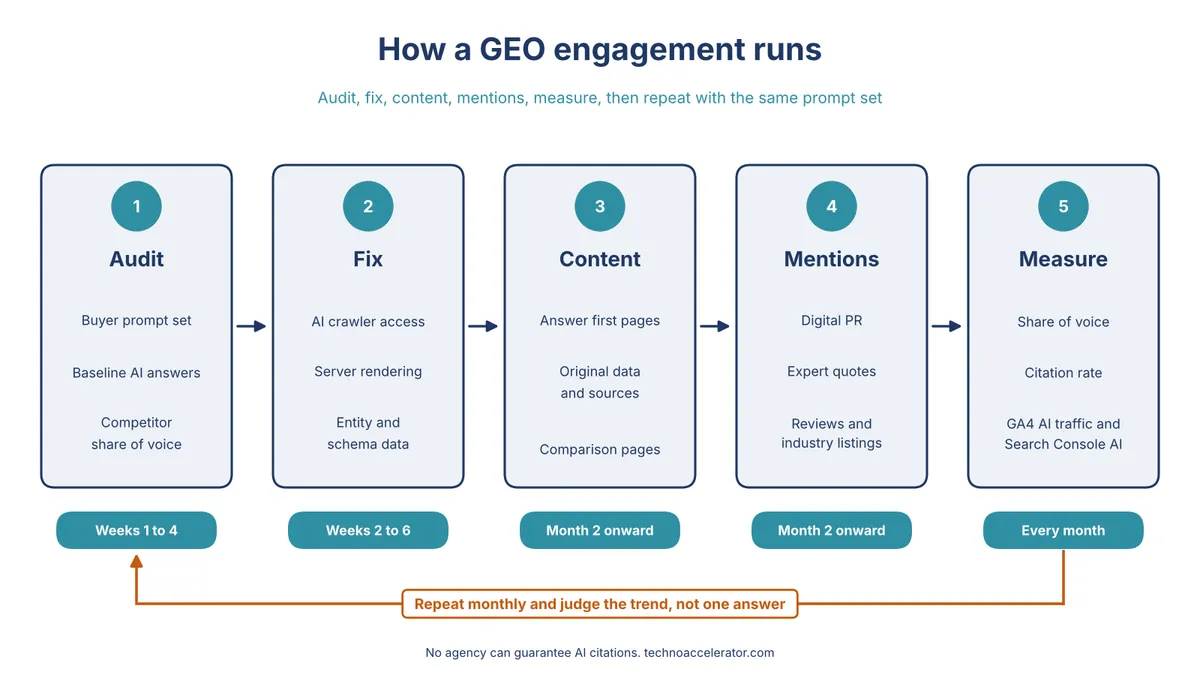
A typical engagement runs roughly like this:
Weeks 1 to 4: prompt set, baseline audit, competitor benchmark.
Weeks 2 to 6: crawler access, rendering and entity fixes.
Month 2 onward: rewrites of priority pages, new comparison and answer content, outreach for mentions.
Months 3 to 6: compare share of voice against the baseline, put more effort into what moved, drop what didn't.
Every month: rerun the same prompt set and report the trend.
Competitive categories like SaaS, finance, legal and healthcare usually take longer, and so do newer brands with few mentions online.
How should a GEO agency measure results?
By tracking how often you appear across many prompts over time, not by sending screenshots of one answer. A good report shows your mention rate, citation rate, share of voice against named competitors, how accurately AI describes you, AI referral traffic in GA4, AI impressions in Search Console, and the leads those visits produce.
AI answers are unstable by design. In a SparkToro study covered by Search Engine Journal, repeated brand recommendation prompts across ChatGPT, Claude and Google's AI returned the same list less than 1 percent of the time. Presence held up far better than position: in one test, the strongest brands appeared in 55 to 77 percent of responses. Ahrefs' guide to tracking AI visibility lands in the same place: aggregate lots of prompts and read the data as a trend.
A useful monthly report covers:
Share of voice: the share of tracked answers that mention you, next to three to five competitors you agreed on at the start.
Citation rate: how often your own pages are linked as sources, and which ones.
Answer accuracy: whether AI tools get your services, prices and locations right. Wrong answers are fixable once someone is checking.
AI referral traffic: since May 13, 2026, GA4 has a built-in AI Assistant channel for visits from tools like ChatGPT, Gemini and Claude. ChatGPT also tags its links with utm_source=chatgpt.com. Clicks from AI Overviews and AI Mode still land in organic search.
Google AI impressions: Search Console's generative AI performance reports show how often your URLs appear in AI Overviews and AI Mode. Google finished rolling them out to all sites on August 31, 2026.
Business results: form fills, calls and booked meetings from AI-referred visits. Small numbers, often high intent.
How much do generative engine optimization services cost?
Industry estimates put most GEO retainers between $1,500 and $50,000 a month, depending on company size and how much content and PR is included. Small businesses usually sit at the low end, and one-off audits are often priced as projects. Treat every published range as a rough guide, since most come from companies selling the service.
Two 2026 roundups, one from WebFX (an agency selling GEO) and one from Nutshell (a CRM software company), give nearly identical ranges: about $1,500 to $5,000 a month for small businesses, $5,000 to $25,000 for mid-sized firms, and $25,000 or more for enterprises. Audits and site overhauls run $5,000 to $50,000 as projects, and AI visibility tracking software alone can cost $50 to over $1,000 a month. Nutshell calls its figures planning estimates, not quotes.
Scope matters more than the fee. Ask how many prompts are tracked, how many pages get reworked each month, whether PR is included, and who pays for the tools.
Should you hire a GEO agency or keep it in-house?
Hire an agency if you don't have people who can handle technical fixes, content and outreach together, or if you want tracking across several AI tools without buying the software yourself. Keep it in-house if you already have a strong SEO and content team and mainly need a process and a tracking tool.
Your SEO work is still the base, since Google says its AI features rely on the same core ranking and quality systems as regular search. Ranking alone isn't enough anymore, though. Ahrefs found that by March 2026 only about 38 percent of URLs cited in AI Overviews also ranked in the top 10, down from roughly 76 percent in July 2025.
Factor | In-house team | GEO agency |
|---|---|---|
Skills | Technical SEO, content, PR and analytics, often across several hires | One team covers it all, if properly staffed |
Tracking tools | You choose, buy and run them | Usually included or passed through at cost |
Speed to start | Slower if you need to hire or train | Faster, usually with an audit in month one |
Brand knowledge | Deep from day one | Takes a few weeks to learn your offer |
Mentions and PR | Hard without media contacts | Easier if the agency has a real PR record |
Cost pattern | Salaries plus software | Monthly retainer (see ranges above) |
Best fit | Larger teams with SEO already working | Small and mid-sized businesses, or stretched teams |
Plenty of businesses go hybrid: the agency runs audits, tracking and outreach, and your team supplies the expertise.
What are the red flags when hiring a generative engine optimization agency?
Walk away from any agency that guarantees citations or a top spot in ChatGPT, sells secret tricks it won't explain, or offers bulk links and paid mentions. AI answers change from run to run and no outside firm controls them. A pitch full of certainty should make you more careful, not less.
Watch for these:
Guaranteed citations or rankings. Google's advice on hiring an SEO says no one can guarantee a #1 ranking, and AI answers are even less stable.
Secret methods or "special access." Google's guide to optimizing for generative AI search says many suggested GEO and AEO hacks don't work, that no third-party tool can see its internal ranking or AI systems, and that chasing inauthentic mentions isn't as helpful as it might seem.
Link schemes, paid mention networks or fake reviews. They risk penalties in Google Search, which is where AI Overviews and AI Mode find their sources.
Hundreds of thin AI-written pages. Google treats mass-produced near-duplicate pages as scaled content abuse.
Promises of FAQ rich results. Google stopped showing them on May 7, 2026. It still reads FAQPage markup, but the dropdowns are gone.
llms.txt sold as the main fix. Google says it will neither help nor hurt your visibility in Google Search.
Screenshot reports and no baseline. One answer on one day proves nothing.
What questions should you ask before you hire a GEO agency?
Ask what they'll deliver each month, how they choose the prompts they track, which AI tools they cover, how they measure share of voice and AI traffic, what they refuse to do, and how they report. Good answers are specific, start from a measured baseline, and never include guaranteed placement.
Copy this checklist into your notes for the next sales call:
What exactly will you deliver in the first 90 days, and in a normal month after that?
How do you build the prompt set, and can we add our own buyer questions?
Which AI tools do you track, and how many times do you run each prompt?
What's our baseline today, and which competitors will you benchmark us against?
How will you report AI referral traffic in GA4 and AI impressions in Search Console?
What will you check in our robots.txt, rendering and server logs?
How do you earn mentions on other sites, and can you show coverage you've secured for real clients?
Do you follow Google Search Essentials and its spam policies?
What's included in the fee, and what costs extra?
What results have you seen, over what timeframe, and can we speak to a current client?
What happens if nothing moves after six months?
Several of these echo Google's own advice on hiring an SEO. Most generative engine optimization companies will handle the first few easily. The last four tend to separate the serious ones from the rest.
How does Techno Accelerator handle GEO for clients?
We start with a baseline audit across ChatGPT, Perplexity, Gemini and Google's AI features, fix access and content issues on your site, then build mentions and track share of voice every month. We don't guarantee citations or rankings. You get the baseline, a record of the work done, and an honest read on what moved.
Techno Accelerator is an AI-powered SEO, AEO and GEO agency based in Lahore, serving businesses across the US, UK and UAE. Whether you call us a GEO agency or a generative AI search engine optimization agency, the checklist above is what we'd want you to ask us. See what's included on our services page, or book a free strategy call and bring your questions.
Frequently asked questions
Can a GEO agency guarantee my brand will appear in ChatGPT?
No. AI answers change from run to run, and the same prompt rarely returns the same list of brands twice. An agency can strengthen the signals AI tools rely on and measure how often you appear, but it can't promise a specific answer.
How long do generative engine optimization services take to work?
Allow three to six months before judging results. Technical fixes can happen in the first month, and tools that search the live web, like Perplexity and ChatGPT search, may reflect changes sooner. Competitive industries and newer brands usually take longer.
How much do GEO services cost?
Published industry ranges run from about $1,500 a month for small businesses to $25,000 or more for large companies, with audits often priced as one-off projects. Most of these figures come from vendors, so compare scope, not just the monthly fee.
Should I block AI crawlers like GPTBot?
It depends on your goals. OpenAI says OAI-SearchBot surfaces sites in ChatGPT search, while GPTBot gathers content that may be used for model training, so some sites allow one and block the other. Blocking Google-Extended won't remove you from AI Overviews, which rely on regular Googlebot.
How do I track traffic from ChatGPT and other AI tools?
Use the AI Assistant channel GA4 added in May 2026, which groups visits from tools like ChatGPT, Gemini and Claude. Clicks from Google's AI Overviews and AI Mode still count as organic search, so check Search Console's generative AI performance report for those impressions.